
|
You entered: hot star
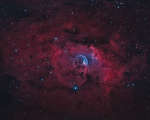 The Bubble Nebula
4.08.2012
Blown by the wind from a massive star, this interstellar apparition has a surprisingly familiar shape. Cataloged as NGC 7635, it is also known simply as The Bubble Nebula. Although it looks delicate, the 10 light-year diameter bubble offers evidence of violent processes at work.
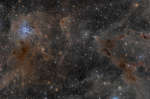 The Iris Nebula in a Field of Dust
12.09.2019
These cosmic dust clouds drift some 1,300 light-years away along the fertile starfields of the constellation Cepheus. The beautiful Iris Nebula, also known as NGC 7023, blossoms at the upper left. Not the only nebula in the sky to evoke the imagery of flowers, its pretty, symmetric form spans about 6 light-years.
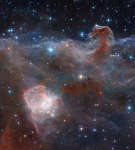 Horsehead: A Wider View
9.03.2018
Combined image data from the massive, ground-based VISTA telescope and the Hubble Space Telescope was used to create this wide perspective of the interstellar landscape surrounding the famous Horsehead Nebula. Captured at near-infrared wavelengths...
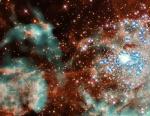 Star Cluster R136 Bursts Out
30.07.2001
In the center of star-forming region 30 Doradus lies a huge cluster of the largest, hottest, most massive stars known. Known as R136, the cluster's energetic stars are breaking out of the cocoon of gas and dust from which they formed.
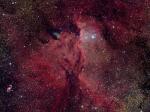 Reflections on NGC 6188
1.06.2006
NGC 6188 is an interstellar carnival of young blue stars, hot red gas, and cool dark dust. Located 4,000 light years away in the disk of our Galaxy, NGC 6188 is home to the Ara OB1 association, a group of bright young stars whose nucleus forms the open cluster NGC 6193.
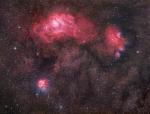 Sagittarius Triplet
9.09.2004
These three bright nebulae are often featured in telescopic tours of the constellation Sagittarius and the view toward the center of our Milky Way galaxy. In fact, 18th century cosmic tourist Charles Messier cataloged two of them; M8, the nebula above and left of center, and colorful M20 at the lower left.
 NGC 604: Giant Stellar Nursery
25.04.2024
Located some 3 million light-years away in the arms of nearby spiral galaxy M33, giant stellar nursery NGC 604 is about 1,300 light-years across. That's nearly 100 times the size of the Milky Way's Orion Nebula, the closest large star forming region to planet Earth.
 Southern Cross Star Colors
8.07.2004
Fix your camera to a tripod, lock the shutter open, and you can easily record an image of star trails, the graceful concentric arcs traced by the stars as planet Earth rotates on its axis.
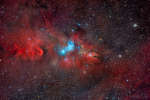 Fox Fur, Unicorn, and Christmas Tree
26.12.2020
Clouds of glowing hydrogen gas fill this colorful skyscape in the faint but fanciful constellation Monoceros, the Unicorn. A star forming region cataloged as NGC 2264, the complex jumble of cosmic gas and dust...
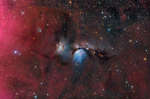 M78 Wide Field
29.12.2017
Interstellar dust clouds and glowing nebulae abound in the fertile constellation of Orion. One of the brightest, M78, is centered in this colorful, wide field view, covering an area north of Orion's belt. At a distance of about 1,500 light-years, the bluish reflection nebula is around 5 light-years across.
|
January February March April May June July |
|||||||||||||||||||||||||||||||||||||||||||||||||