
|
You entered: nearest stars
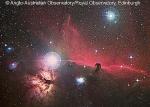 Orion's Horsehead Nebula
27.08.2000
The Horsehead Nebula is one of the most famous nebulae on the sky. It is visible as the black indentation to the red emission nebula seen just to the right of center of the above photograph. The bright star near the center is located in the belt of the familiar constellation of Orion.
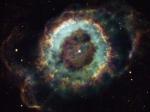 NGC 6369: The Little Ghost Nebula
8.11.2002
This pretty planetary nebula, cataloged as NGC 6369, was discovered by 18th century astronomer William Herschel as he used a telescope to explore the constellation Ophiucus. Round and planet-shaped, the nebula is also relatively faint and has acquired the popular moniker of Little Ghost Nebula.
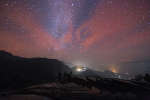 The Terraced Night
6.02.2014
Long after sunset on January 25 an unusually intense red airglow floods this south-looking skyscape. The scene was recorded with a long exposure using a digital camera over Yunnan Province in southwest China. At best faintly visible to the eye, the lingering airglow is due to chemiluminescence, the production of light through chemical excitation.
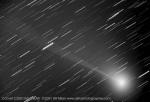 C 2001 A2 (LINEAR): Comet
5.07.2001
Comet C/2001 A2 (LINEAR) has crossed the celestial equator and is heading north. Outward bound, this primordial piece of the solar system is still just visible to the unaided eye and can now be sighted by northern hemisphere skygazers as it moves through the constellation Pisces.
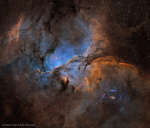 NGC 6188 and NGC 6164
30.03.2016
Fantastic shapes lurk in clouds of glowing gas in the giant star forming region NGC 6188. The emission nebula is found about 4,000 light years away near the edge of a large molecular cloud unseen at visible wavelengths, in the southern constellation Ara.
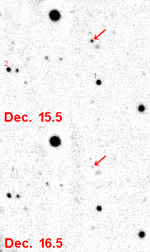 Gamma-ray Burster
18.12.1997
Gamma-ray bursts seem to be the most powerful explosions in the Universe. Yet their sources continue to elude researchers who stand in awe and frustration at the bursts' transient, enigmatic behavior. The blinking gif above illustrates the latest hard-won result in the quest to identify and understand the nature of the bursters.
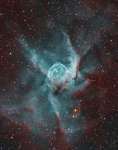 NGC 2359: Thor s Helmet
16.02.2019
NGC 2359 is a helmet-shaped cosmic cloud with wing-like appendages popularly called Thor's Helmet. Heroically sized even for a Norse god, Thor's Helmet is about 30 light-years across. In fact, the helmet...
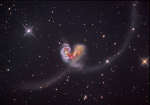 The Antennae
7.05.2010
Some 60 million light-years away in the southerly constellation Corvus, two large galaxies collided. But the stars in the two galaxies cataloged as NGC 4038 and NGC 4039 don't collide in the course of the ponderous, billion year or so long event.
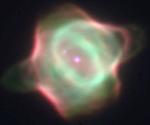 Hen 1357: New Born Nebula
3.04.1998
This Hubble Space Telescope picture shows Hen-1357, the youngest known planetary nebula. Graceful, gentle curves and symmetry suggest its popular name - The Stingray Nebula. Observations in the 1970s detected no nebular material, but this image from March 1996 clearly shows the Stingray's emerging bubbles and rings of shocked and ionized gas.
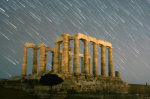 Celestial Trails over Greece
4.05.2011
If you watch the horizon at just the right place and at just the right time, you can witness some spectacular juxtapositions between Earth and sky. In the above video, stars, the Moon, and even a partially eclipsed Sun were recorded rising and setting over photogenic landmarks in Greece.
|
January February March April May June July August September |
|||||||||||||||||||||||||||||||||||||||||||||||||