
|
You entered: night sky
 APOD: 2024 June 11 Б Colorful Stars and Clouds near Rho Ophiuchi
11.06.2024
Why is the sky near Antares and Rho Ophiuchi so colorful, yet dusty? The colors result from a mixture of objects and processes. Fine dust -- illuminated by starlight -- produces blue reflection nebulae. Gaseous clouds whose atoms are excited by ultraviolet starlight produce reddish emission nebulae. Backlit dust clouds block starlight and so appear dark.
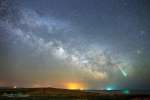 Meteor in the Milky Way
23.04.2015
Earth's April showers include the Lyrid Meteor Shower, observed for more than 2,000 years when the planet makes its annual passage through the dust stream of long-period Comet Thatcher. A grain...
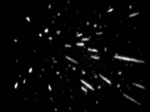 Quadrantids: Meteors in Perspective
26.01.1996
Meteor showers are caused by streams of solid particles, dust size and larger, moving as a group through space. In many cases, the orbits of these meteor streams can be identified with the dust tails of comets.
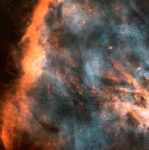 The Great Nebula in Orion
3.07.1995
The Great Nebula in Orion, M42, can be found on the night sky just below and to the left of the easily identifiable belt of three stars in the popular constellation Orion. This nebula is one of the closest stellar nurseries - where young stars are being formed even now.
 Mars in a Manger
30.04.2010
At opposition in late January, Mars shone very brightly in planet Earth's night sky, among the stars of the constellation Cancer the Crab. Since then the Red Planet has been fading, but still lingers in Cancer during April and May.
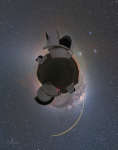 Little Planet to Exoplanets
14.09.2019
Of course this little planet is really planet Earth in a digitally stitched 360 x 180 degree mosaic captured high in the Chilean Atacama desert. The seemingly large domes house the 1-meter diameter telescopes of the SPECULOOS Southern Observatory.
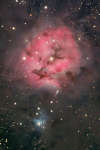 IC 5146: The Cocoon Nebula
27.08.2022
Inside the Cocoon Nebula is a newly developing cluster of stars. Cataloged as IC 5146, the beautiful nebula is nearly 15 light-years wide. Climbing high in northern summer night skies, it's located some 4,000 light years away toward the constellation Cygnus the Swan.
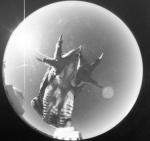 A New Constellation Takes Hold
1.04.2003
A new constellation has taken hold of the sky, much to the surprise of many sky gazers. The constellation of Ollie the Owl has suddenly started dominating the southern hemisphere, as shown above. The constellation is taking the place of Wrinkles the Rhinoceros, who was unexpectedly voted off they sky by the other constellations.
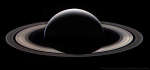 Saturn at Night
26.11.2022
Saturn is still bright in planet Earth's night skies. Telescopic views of the distant gas giant and its beautiful rings often make it a star at star parties. But this stunning view of Saturn's rings and night side just isn't possible from telescopes closer to the Sun than the outer planet.
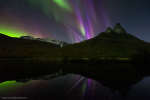 Aurora and Fireball Over Norway
5.10.2012
What's happening behind that mountain? A convergence of variable sky spectacles. One night in mid-September near TromsЬ, Norway, high red aurora could be seen shimmering through lower green aurora in a way that created a striking and somewhat unusual violet glow.
|
January February March April May June July August September October |
|||||||||||||||||||||||||||||||||||||||||||||||||