
|
You entered: ring galaxy
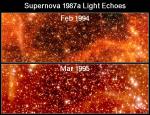 Moving Echoes Around SN 1987A
24.10.1997
Yesterday's image highlighted reflective rings of light emitted by a supernova explosion. Today's pictures, taken over a year apart, highlight how these echoes are seen to move over time. Visible...
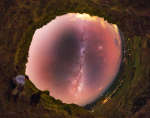 A Sky Portal in New Zealand
29.07.2014
To some, it may look like a portal into the distant universe. To others, it may appear as the eye of a giant. Given poetic license, both are correct. Pictured above is a standard fisheye view of the sky -- but with an unusual projection.
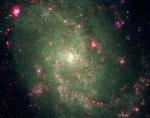 Elements of Nearby Spiral M33
27.09.2001
Spiral galaxy M33 is a mid-sized member of our Local Group of Galaxies. M33 is also called the Triangulum Galaxy for the constellation in which it resides. About four times smaller (in radius) than...
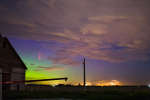 Stars, Sprites, Clouds, Auroras
3.02.2015
What are those red streaks in the sky? While photographing unexpected auroras over a distant thunderstorm, something extraordinary happened: red sprites. This brief instance of rarely imaged high-altitude lightning flashed so bright that it was witnessed by several people independently.
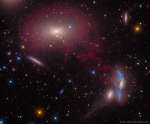 M86 in the Central Virgo Cluster
14.08.2018
Is there a bridge of gas connecting these two great galaxies? Quite possibly, but it is hard to be sure. M86 on the upper left is a giant elliptical galaxy near the center of the nearby Virgo Cluster of galaxies.
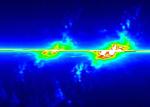 Streaming From A Black Hole
13.06.1997
Glowing gas clouds are streaming from the core of galaxy NGC4151 at hundreds of thousands of miles per hour. A powerful tool, the Hubble Space Telescope's new STIS instrument, makes it possible to map out the cloud velocities - producing this false color "velocity map" for the central regions of NGC4151.
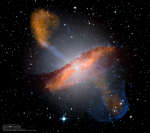 Centaurus As Warped Magnetic Fields
21.04.2021
When galaxies collide -- what happens to their magnetic fields? To help find out, NASA pointed SOFIA, its flying 747, at galactic neighbor Centaurus A to observe the emission of polarized dust -- which traces magnetic fields.
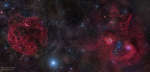 Downtown Auriga
13.02.2014
Rich in star clusters and nebulae, the ancient constellation of Auriga, the Charioteer, rides high in northern winter night skies. Spanning nearly 24 full moons (12 degrees) on the sky, this deep telescopic mosaic view recorded in January shows off some of Auriga's most popular sights for cosmic tourists.
 M81: A Bulging Spiral Galaxy
13.07.1996
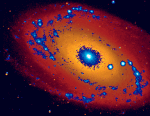
Few stars are still forming in the old giant spiral galaxy M81. The blue regions in this picture - representing ultraviolet light - highlight regions of bright young stars and star formation and appear rare than in M74 and M33. The red regions - representing the visible light - show a large population of older, less massive stars.
 Cygnus Without Stars
30.11.2020
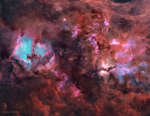
The sky is filled with faintly glowing gas, though it can take a sensitive camera and telescope to see it. For example, this twelve-degree-wide view of the northern part of the constellation Cygnus reveals a complex array of cosmic clouds of gas along the plane of our Milky Way galaxy.
|
January February March April May June July August September October |
|||||||||||||||||||||||||||||||||||||||||||||||||