
|
You entered: star
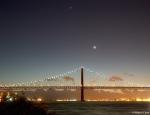 Lisbon Moonset
24.03.2007
Brilliant Venus, a slender crescent Moon, and lights along the Ponte 25 de Abril glow against the western twilight in this lovely moonset scene from Lisbon, Portugal, recorded on March 20. In fact, such...
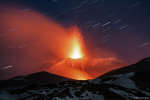 Mt. Etna Lava Plume
26.04.2017
Mt. Etna has been erupting for hundreds of thousands of years. Located in Sicily, Italy, the volcano produces lava fountains over one kilometer high. Mt. Etna is not only one of the most active...
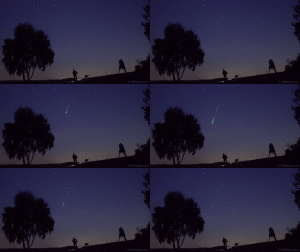 Real Time Perseid
8.09.2018
Bright meteors and dark night skies made this year's Perseid meteor shower a great time for a weekend campout. And while packing away their equipment, skygazers at a campsite in the mountains...
 Breaking Distant Light
20.09.2020
In the distant universe, time appears to run slowly. Since time-dilated light appears shifted toward the red end of the spectrum (redshifted), astronomers are able to use cosmological time-slowing to help measure vast distances in the universe.
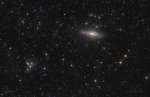 Galaxies in Pegasus
15.10.2020
This sharp telescopic view reveals galaxies scattered beyond the stars of the Milky Way, at the northern boundary of the high-flying constellation Pegasus. Prominent at the upper right is NGC 7331. A mere...
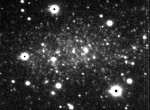 The Closest Galaxy: The Sagittarius Dwarf
4.02.1996
What's the closest galaxy to our Milky Way? For many years astronomers thought it was the Large Magellanic Cloud (LMC). But the seemingly insignificant fuzzy patch shown above turned out to be part of a galaxy that is even closer.
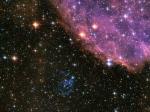 Supernova Remnant E0102 from Hubble
29.08.2006
It's the blue wisp near the bottom that's the remnant of a tremendous recent supernova explosion. The large pink structure looming to the upper right is part of N76, a large star forming region in our neighboring Small Magellanic Cloud (SMC) galaxy. The supernova remnant wisp, with full coordinate name 1E0102.
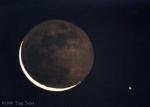 Mercury And The Moon
11.11.1999
Mercury is the closest planet to the Sun and never moves far from our parent star in Earth's sky. Racing around its tight orbit, this well-done world is a little over 1/3 the diameter of Earth and is often lost to our view in the solar glare.
 Moonrise Eclipse
2.02.2018
This atmospheric picture of a distant horizon looks toward the tall Trisul peaks of India's snowy Himalayan mountains. Taken from a remote location on January 31, brightest star Sirius shines at the upper right. The red Moon rising is gliding through Earth's shadow during the evening's much anticipated total lunar eclipse.
 Heaven on Earth
6.11.2000
If sometimes it appears that the entire Milky Way Galaxy is raining down on your head, do not despair. It happens twice a day. As the Sun rises in the East, wonders of the night sky become less bright than the sunlight scattered by our own Earth's atmosphere, and so fade from view.
|
January February March April May June July August September October |
|||||||||||||||||||||||||||||||||||||||||||||||||