
|
You entered: stars
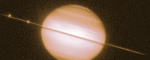 Crossing The Ring Plane
1.08.1995
"I do not know what to say in a case so surprising, so unlooked for and so novel." announced Galileo when Saturn's rings appeared to vanish in 1612. In fact, every 15 years Saturn's rings seem to almost disappear as viewed from the Earth.
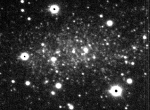 The Closest Galaxy: The Sagittarius Dwarf
29.03.1997
What's the closest galaxy to our Milky Way? For many years astronomers thought it was the Large Magellanic Cloud (LMC). But the seemingly insignificant fuzzy patch shown above turned out to be part of a galaxy that is even closer.
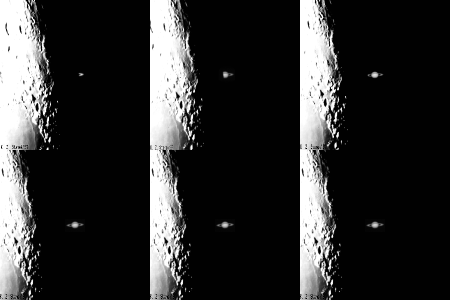 Moon Occults Saturn
8.05.1999
On September 18, 1997, many stargazers in the U. S. were able to watch a lovely early morning lunar occultation as a bright Moon passed in front of Saturn. Using a 1.2 meter reflector, astronomer Kris Stanek had an excellent view of this dream-like event from the Whipple Observatory atop Arizona's Mount Hopkins.
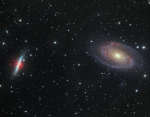 Galaxy Wars: M81 versus M82
24.03.2010
On the right, surrounded by blue spiral arms, is spiral galaxy M81. On the left, marked by red gas and dust clouds, is irregular galaxy M82. This stunning vista shows these two mammoth galaxies locked in gravitational combat, as they have been for the past billion years.
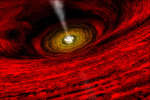 GRO J1655 40: Evidence for a Spinning Black Hole
5.09.2010
In the center of a swirling whirlpool of hot gas is likely a beast that has never been seen directly: a black hole. Studies of the bright light emitted by the swirling gas frequently indicate not only that a black hole is present, but also likely attributes.
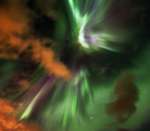 Cloudy Night of the Northern Lights
30.09.2011
On September 26, a large solar coronal mass ejection smacked into planet Earth's magnetosphere producing a severe geomagnetic storm and wide spread auroras. Captured here near local midnight from Kvaløya island outside Tromsø in northern Norway, the intense auroral glow was framed by parting rain clouds.
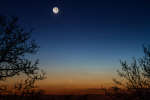 PanSTARRS from France
16.03.2013
Still looking for that comet? Comet PanSTARRS (C/2011 L4) naked-eye appearance in the northern hemisphere is described by successful comet spotters as a dim star with faint a tail. If you want to catch it the next few days could be your best bet.
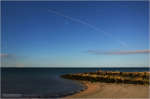 The Trail of a Minotaur
21.11.2013
Star trails arc above a moonlit beach and jetty in this serene sea and night skyscape. Captured on November 19, the single time exposure looks south down the Atlantic coast from Cape Cod, Massachusetts, USA.
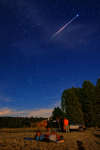 Perseid from Torralba del Burgo
13.08.2016
Perseid meteors rained on planet Earth last night. This year the stream of dust from periodic comet Swift-Tuttle has produced a stunningly active shower of bright cosmic streaks. In this 25 second long exposure...
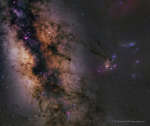 Saturn in the Milky Way
10.06.2017
Saturn is near opposition in planet Earth's sky. Rising at sunset and shining brightly throughout the night, it also lies near a line-of-sight to crowded starfields, nebulae, and obscuring dust clouds along the Milky Way.
|
January February March April May June July August September October |
|||||||||||||||||||||||||||||||||||||||||||||||||