
|
You entered: image
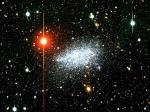 Leo A: Nearby Dwarf Irregular Galaxy
10.11.2004
Why isn't this small galaxy simple? The above image and contemporary observations of small nearby galaxy Leo A were supposed to show it has a simple structure. Now Leo A is known...
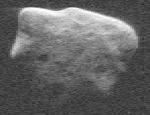 1999 JM8: A Rock Too Close
1.09.1999
Nearly four kilometers across, the huge rock known as 1999 JM8 silently passed only 8.5 million kilometers from the Earth in early August. The small asteroid was completely unknown before May. Every few centuries, a rock like this impacts the Earth, with the potential to disrupt modern civilization.
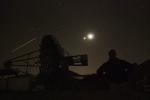 VERITAS and Venus
8.11.2007
Early morning risers and late to bed astronomers have recently enjoyed bright planets in predawn skies, with brilliant Venus above the eastern horizon. On November 5, Venus was joined by the waning crescent Moon.
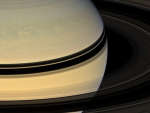 Saturns Rings from the Other Side
9.06.2008
What do Saturn's rings look like from the other side? From Earth, we usually see Saturn's rings from the same side of the ring plane that the Sun illuminates them. Geometrically...
 The Colors of IC 1795
10.12.2009
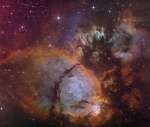
This colorful cosmic portrait features glowing gas and dark dust clouds in IC 1795, a star forming region in the northern constellation Cassiopeia. The nebula's colors were created by adopting the Hubble false-color...
 The Veil Nebula
16.09.2010
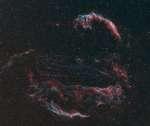
Delicate in appearance, these filaments of shocked, glowing gas, draped in planet Earth's sky toward the constellation of Cygnus, make up the Veil Nebula. The nebula is a large supernova remnant, an expanding cloud born of the death explosion of a massive star.
 Saturn: Light, Dark, and Strange
12.10.2010
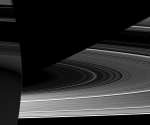
What's creating those dark bands on Saturn? Sometimes it takes a little sleuthing to figure out the how and why of a picture taken by the Saturn-orbiting Cassini spacecraft. Let's see. That large orb on the left must be Saturn itself. Those arcs on the right are surely the rings.
 Full Moonrise
5.05.2012
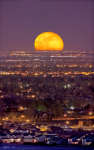
Rising as the Sun sets, tonight's Full Moon could be hard to miss. Remarkably, its exact full phase (May 6 03:36 UT) will occur less than two minutes after it reaches perigee, the closest point to Earth in the Moon's orbit, making it the largest Full Moon of 2012.
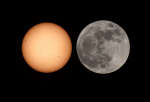 Sun vs Super Moon
11.05.2012
The Super Moon wins, by just a little, when its apparent size is compared to the Sun in this ingenious composite picture. To make it, the Full Moon on May 6 was photographed with the same camera and telescope used to image the Sun (with a dense solar filter!) on the following day.
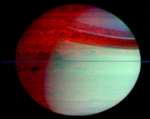 Lantern Saturn
31.05.2012
Known for its bright ring system and many moons, gas giant Saturn looks strange and unfamiliar in this false-color view from the Cassini spacecraft. In fact, in this Visual and Infrared Mapping Spectrometer (VIMS) mosaic the famous rings are almost invisible, seen edge-on cutting across picture center.
|
January February March April May June July August September |
|||||||||||||||||||||||||||||||||||||||||||||||||