
|
You entered: Ring Nebula
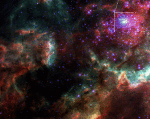 In the Center of 30 Doradus
4.10.1997
In the center of 30 Doradus lies a huge cluster of the largest, hottest, most massive stars known. The center of this cluster, known as R136, is boxed in the upper right portion of the above picture.
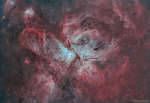 The Great Nebula in Carina
7.05.2019
What's happening in the center of the Carina Nebula? Stars are forming, dying, and leaving an impressive tapestry of dark dusty filaments. The entire Carina Nebula, cataloged as NGC 3372, spans over 300 light years and lies about 8,500 light-years away in the constellation of Carina.
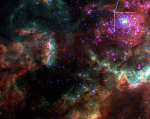 In the Center of 30 Doradus
21.02.1999
In the center of 30 Doradus lies a huge cluster of the largest, hottest, most massive stars known. The center of this cluster, known as R136, is boxed in the upper right portion of the above picture.
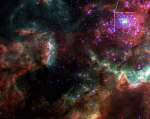 In the Center of 30 Doradus
24.05.1996
In the center of 30 Doradus lies a huge cluster of the largest, hottest, most massive stars known. The center of this cluster, known as R136, is boxed in the upper right portion of the above picture.
 Stars, Gas, and Dust Battle in the Carina Nebula
15.08.2017
Chaos reigns in the Carina Nebula where massive stars form and die. Striking and detailed, this close-up of a portion of the famous nebula is a combination of light emitted by hydrogen (shown in red) and oxygen (shown in blue).
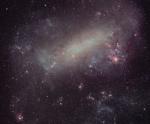 The Large Cloud of Magellan
2.09.2004
Portuguese navigator Fernando de Magellan and his crew had plenty of time to study the southern sky during the first circumnavigation of planet Earth. As a result, two fuzzy cloud-like objects easily visible for southern hemisphere skygazers are known as the Clouds of Magellan.
 APOD: 2024 February 5 Б In the Core of the Carina Nebula
5.02.2024
What's happening in the core of the Carina Nebula? Stars are forming, dying, and leaving an impressive tapestry of dark dusty filaments. The entire Carina Nebula, cataloged as NGC 3372, spans over 300 light years and lies about 8,500 light-years away in the constellation of Carina.
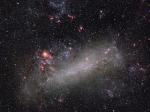 The Large Cloud of Magellan
10.05.2006
Portuguese navigator Fernando de Magellan and his crew had plenty of time to study the southern sky during the first circumnavigation of planet Earth. As a result, two fuzzy cloud-like objects easily visible for southern hemisphere skygazers are known as the Clouds of Magellan.
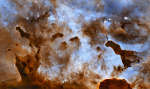 Dark Clouds of the Carina Nebula
19.09.2010
What dark forms lurk in the mists of the Carina Nebula? These ominous figures are actually molecular clouds, knots of molecular gas and dust so thick they have become opaque. In comparison, however, these clouds are typically much less dense than Earth's atmosphere.
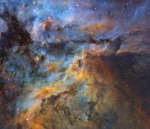 South of Carina
22.05.2020
With natal dust clouds in silhouette against glowing atomic gas, this colorful and chaotic vista lies within one of the largest star forming regions in the Milky Way galaxy, the Great Carina Nebula.
|
January February March April May June July August September October |
|||||||||||||||||||||||||||||||||||||||||||||||||