
|
You entered: Solar System
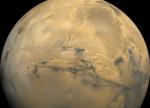 Valles Marineris: The Grand Canyon of Mars
24.08.2003
The largest canyon in the Solar System cuts a wide swath across the face of Mars. Named Valles Marineris, the grand valley extends over 3,000 kilometers long, spans as much as 600 kilometers across, and delves as much as 8 kilometers deep.
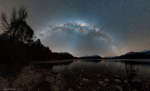 Galaxy by the Lake
10.09.2022
This 180 degree panoramic night skyscape captures our Milky Way Galaxy as it arcs above the horizon on a winter's night in August. Near midnight, the galactic center is close to the zenith with the clear waters of Lake Traful, Neuquen, Argentina, South America, planet Earth below.
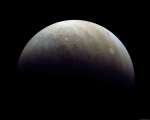 Southern Jupiter from Perijove 3
17.12.2016
Southern Jupiter looms some 37,000 kilometers away in this JunoCam image from December 11. The image data was captured near Juno's third perijove or closest approach to Jupiter, the spacecraft still in its 53 day long looping orbit.
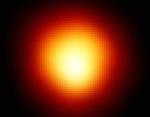 Betelgeuse
19.04.1998
Here is the first direct picture of the surface of a star other than our Sun. Taken by the Hubble Space Telescope in 1995, the atmosphere of Betelgeuse reveals some unexpected features, including a large bright hotspot visible below the center.
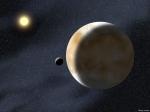 UB313: Larger than Pluto
7.02.2006
What do you call an outer Solar System object that is larger than Pluto? Nobody is yet sure. The question arose recently when 2003 UB313, an object currently twice as far out as Pluto and not in the plane with the rest of the planets, was verified recently to be 30 percent wider than Pluto.
 Two Hours Before Neptune
5.10.1999
Two hours before closest approach to Neptune in 1989, the Voyager 2 robot spacecraft snapped this picture. Clearly visible for the first time were long light-colored cirrus-type clouds floating high in Neptune's atmosphere. Shadows of these clouds can even be seen on lower cloud decks.
 Comet Between Fireworks and Lightning
5.07.2008
Sometimes the sky itself is the best show in town. Last January, people from Perth, Australia gathered on a local beach to watch a sky light up with delights near and far. Nearby, fireworks exploded as part of Australia Day celebrations. On the far right, lightning from a thunderstorm flashed in the distance.
 Comet NEOWISE from the ISS
10.07.2020
Rounding the Sun on July 3rd and currently headed for the outer Solar System, Comet NEOWISE (C/2020 F3) has been growing brighter in the predawn skies of planet Earth. From low Earth orbit...
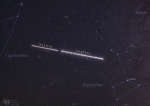 Saturn and Jupiter in Summer 2020
12.12.2020
During this northern summer Saturn and Jupiter were both near opposition, opposite the Sun in planet Earth's sky. Their paired retrograde motion, seen about every 20 years, is followed from 19 June through 28 August in this panoramic composite as they wander together between the stars in western Capricornus and eastern Sagittarius.
 APOD: 2024 November 10 Б Valles Marineris: The Grand Canyon of Mars
10.11.2024
The largest canyon in the Solar System cuts a wide swath across the face of Mars. Named Valles Marineris, the grand valley extends over 3,000 kilometers long, spans as much as 600 kilometers across, and delves as much as 8 kilometers deep.
|
January February March April May June July August |
||||||||||||||||||||||||||||||||||||||||||||||||||||||||