
|
You entered: clouds
 APOD: 2023 June 14 Б The Shark Nebula
14.06.2023
There is no sea on Earth large enough to contain the Shark nebula. This predator apparition poses us no danger as it is composed only of interstellar gas and dust. Dark dust like that featured here is somewhat like cigarette smoke and created in the cool atmospheres of giant stars.
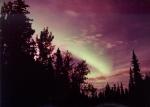 Aurora at Midnight
5.05.1998
What's happening behind those trees? Aurora. This picture was taken at midnight near Fairbanks, Alaska, and captures familiar trees, common clouds, and a glowing sky markedly different than a sunset. Particularly strange is the green auroral ring caused by ionized oxygen high in the Earth's atmosphere.
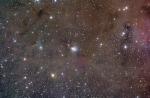 Stardust in Perseus
29.11.2007
This cosmic expanse of dust, gas, and stars covers some 4 degrees on the sky in the heroic constellation Perseus. Centered in the gorgeous skyscape is the dusty blue reflection nebula NGC 1333, about 1,000 light-years away. At that estimated distance, the field of view is nearly 70 light-years across.
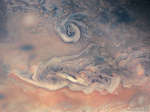 Swirls and Colors on Jupiter from Juno
21.11.2018
What creates the colors in Jupiter's clouds? No one is sure. The thick atmosphere of Jupiter is mostly hydrogen and helium, elements which are colorless at the low temperatures of the Jovian cloud tops.
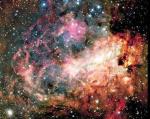 M17: Omega Nebula Star Factory
10.12.2002
In the depths of the dark clouds of dust and molecular gas known as M17, stars continue to form. The similarity to the Greek letter capital Omega gives the molecular cloud its popular name, but the nebula is also known as the Swan Nebula, the Horseshoe Nebula, and M17.
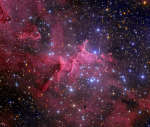 Melotte 15 in the Heart
27.12.2013
Cosmic clouds seem to form fantastic shapes in the central regions of emission nebula IC 1805. Of course, the clouds are sculpted by stellar winds and radiation from massive hot stars in the nebula's newborn star cluster, Melotte 15.
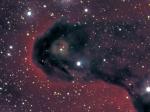 VDB 142 in Cepheus
11.10.2001
A gorgeous collection of dust and gas nebulae in the Northern Milky Way graces the high and far off constellation of Cepheus. With colors based on astronomical filters, this close up of the region highlights stars embedded in curiously shaped cosmic clouds.
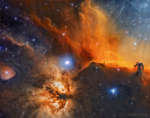 The Horsehead and Flame Nebulas
3.11.2021
The Horsehead Nebula is one of the most famous nebulae on the sky. It is visible as the dark indentation to the orange emission nebula at the far right of the featured picture. The horse-head feature is dark because it is really an opaque dust cloud that lies in front of the bright emission nebula.
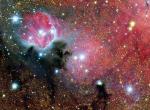 East of the Lagoon Nebula
20.05.2002
To the east of the Lagoon Nebula is a star field rich in diversity. On the lower left are clouds rich in dark dust that hide background stars and young star systems still forming. Dark clouds include LDN 227 on the left and IC 1275 on the right, with a bright star near its tip.
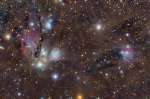 NGC 2170: Celestial Still Life
14.01.2013
In this celestial still life composed with a cosmic brush, dusty nebula NGC 2170 shines left of image center. Reflecting the light of nearby hot stars, NGC 2170 is joined by other bluish reflection nebulae, a red emission region, many dark absorption nebulae, and a backdrop of colorful stars.
|
January February March April May June July August September October |
|||||||||||||||||||||||||||||||||||||||||||||||||