
|
You entered: dust lanes
 APOD: 2025 June 24 Б In the Center of Spiral Galaxy M61
24.06.2025
Is there a spiral galaxy in the center of this spiral galaxy? Sort of. Image data from the Hubble Space Telescope, the European Southern Observatory, and smaller telescopes on planet Earth are combined in this detailed portrait of face-on spiral galaxy Messier 61 (M61) and its bright center.
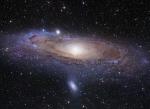 Andromeda Island Universe
22.12.2005
The most distant object easily visible to the unaided eye is M31, the great Andromeda Galaxy some two million light-years away. But without a telescope, even this immense spiral galaxy - spanning over 200,000 light years - appears as a faint, nebulous cloud in the constellation Andromeda.
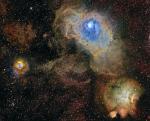 Three Nebulae in Narrow Band
2.11.2007
Narrow band filters and a false-color palette give these three nebulae a stunning appearance against the cosmic canvas of the central Milky Way. All three are stellar nurseries about 5,000 light-years or so distant, toward the nebula rich constellation Sagittarius.
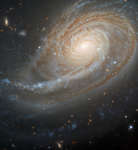 Arp 78: Peculiar Galaxy in Aries
24.03.2022
Peculiar spiral galaxy Arp 78 is found within the boundaries of the head strong constellation Aries. Some 100 million light-years beyond the stars and nebulae of our Milky Way galaxy, the island universe is over 100,000 light-years across.
 APOD: 2025 January 6 Б Colliding Spiral Galaxies from Webb and Hubble
6.01.2025
Billions of years from now, only one of these two galaxies will remain. Until then, spiral galaxies NGC 2207 and IC 2163 will slowly pull each other apart, creating tides of matter, sheets of shocked gas, lanes of dark dust, bursts of star formation, and streams of cast-away stars.
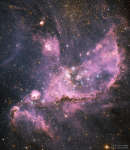 NGC 346: Star Forming Cluster in the SMC
1.12.2020
Are stars still forming in the Milky Way's satellite galaxies? Found among the Small Magellanic Cloud's (SMC's) clusters and nebulas, NGC 346 is a star forming region about 200 light-years across, pictured here in the center of a Hubble Space Telescope image.
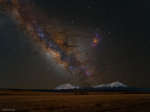 Milky Way Over the Spanish Peaks
24.05.2016
That's not lightning, and it did not strike between those mountains. The diagonal band is actually the central band of our Milky Way Galaxy, while the twin peaks are actually called the Spanish Peaks -- but located in Colorado, USA.
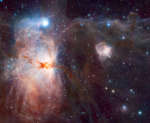 The Flame Nebula in Infrared
12.01.2010
What lights up the Flame Nebula? Fifteen hundred light years away towards the constellation of Orion lies a nebula which, from its glow and dark dust lanes, appears, on the left, like a billowing fire. But fire, the rapid acquisition of oxygen, is not what makes this Flame glow.
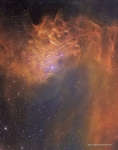 IC 405: The Flaming Star Nebula
7.01.2020
Rippling dust and gas lanes give the Flaming Star Nebula its name. The orange and purple colors of the nebula are present in different regions and are created by different processes. The bright star...
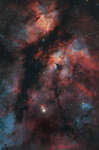 The Gamma Cygni Nebula
18.06.2022
Supergiant star Gamma Cygni is at the center of the Northern Cross. Near the plane of our Milky Way galaxy, that famous asterism flies high in northern summer night skies in the constellation Cygnus the Swan.
|
January February March April May June July August September |
|||||||||||||||||||||||||||||||||||||||||||||||||