
|
You entered: ring galaxy
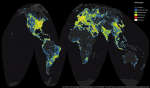 The New World Atlas of Artificial Sky Brightness
30.06.2016
How far are you from a naturally dark night sky? In increasing steps, this world map (medium | large) shows the effect of artificial night sky brightness on the visual appearance of the night sky. The brightness was modeled using high resolution satellite data and fit to thousands of night sky brightness measurements in recent work.
 APOD: 2023 September 25 Б Arp 142: The Hummingbird Galaxy
25.09.2023
What's happening to this spiral galaxy? Just a few hundred million years ago, NGC 2936, the upper of the two large galaxies shown at the bottom, was likely a normal spiral galaxy -- spinning, creating stars -- and minding its own business.
 The Hydrogen Clouds of M33
30.09.2021
Gorgeous spiral galaxy M33 seems to have more than its fair share of glowing hydrogen gas. A prominent member of the local group of galaxies, M33 is also known as the Triangulum Galaxy and lies a mere 3 million light-years away.
 Northern Lights from the Stratosphere
18.01.2024
Northern lights shine in this night skyview from planet Earth's stratosphere, captured on January 15. The single, 5 second exposure was made with a hand-held camera on board an aircraft above Winnipeg, Canada. During the exposure, terrestrial lights below leave colorful trails along the direction of motion of the speeding aircraft.
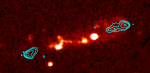 An Energetic Radio Galaxy
30.09.1995
The radio and optical emission seen in the above superposed images of the radio galaxy 3C368 indicate that energetic processes are at work. A radio galaxy is a galaxy that is visible to radio telescopes. A large radio signal usually indicates very powerful phenomena.
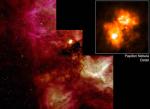 N159 and the Papillon Nebula
14.06.1999
In a search for massive stars, the Hubble Space Telescope has peered into yet another spectacular region of star formation. This nebula, known as N159, spans over 150 light-years and is located in the neighboring Large Magellanic Cloud galaxy, about 170,000 light years distant.
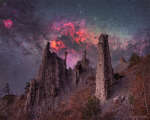 Milky Way over French Alp Hoodoos
16.05.2022
Real castles aren't this old. And the background galaxy is even older. Looking a bit like an alien castle, the pictured rock spires are called hoodoos and are likely millions of years old. Rare, but found around the world, hoodoos form when dense rocks slow the erosion of softer rock underneath.
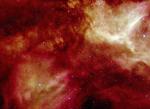 N159 and the Papillon Nebula
21.12.2003
In a search for massive stars, the Hubble Space Telescope has peered into yet another spectacular region of star formation. This nebula, known as N159, spans over 150 light-years and is located in the neighboring Large Magellanic Cloud galaxy, about 170,000 light years distant.
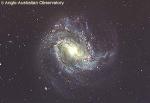 M83: A Barred Spiral Galaxy
26.09.1999
M83 is a bright spiral galaxy that can be found with a small telescope in the constellation of Hydra. It takes light about 15 million years to reach us from M83. M83 is quite a typical spiral - much like our own Milky Way Galaxy.
 APOD: 2024 July 22 Б Chamaeleon Dark Nebulas
22.07.2024
Sometimes the dark dust of interstellar space has an angular elegance. Such is the case toward the far-south constellation of Chamaeleon. Normally too faint to see, dark dust is best known for blocking visible light from stars and galaxies behind it.
|
January February March April May June July August September October |
|||||||||||||||||||||||||||||||||||||||||||||||||