
|
You entered: image
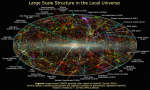 The Universe Nearby
11.12.2007
What does the universe nearby look like? This plot shows over one and a half million of the brightest stars and galaxies in the nearby universe detected by the Two Micron All Sky Survey (2MASS) in infrared light.
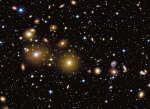 The Perseus Cluster of Galaxies
20.05.2008
Here is one of the largest objects that anyone will ever see on the sky. Each of these fuzzy blobs is a galaxy, together making up the Perseus Cluster, one of the closest clusters of galaxies. The cluster is seen through a foreground of faint stars in our own Milky Way Galaxy.
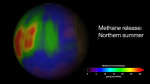 Methane Discovered in the Atmosphere of Mars
19.01.2009
Why is there methane on Mars? No one is sure. An important confirmation that methane exists in the atmosphere of Mars occurred last week, bolstering previous controversial claims made as early as 2003.
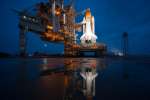 Atlantis Reflection
9.07.2011
Space shuttle orbiter Atlantis left planet Earth on Friday, July 8, embarking on the STS-135 mission to the International Space Station. The momentous launch was the final one in NASA's 30 year space shuttle program that began with the launch of the first reusable spacecraft on April 12, 1981.
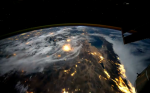 Flying over Planet Earth
27.09.2011
Have you ever dreamed of flying high above the Earth? Astronauts visiting the International Space Station do this every day, circling our restless planet twice every three hours. A dramatic example of their view was compiled in the above time-lapse video from images taken earlier this month.
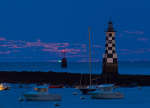 Green Flash and Super Moon
10.05.2012
It was really not about superheroes as on May 6 the much touted Super Moon, the largest Full Moon of 2012, rose over this otherwise peaceful harbor. And no supervillains were present either as boats gently rocked at their moorings near the checkerboard La Perdrix lighthouse on the coast of Brittany, France.
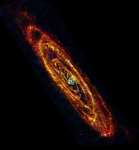 Herschel s Andromeda
2.02.2013
This infrared view from the Herschel Space Observatory explores the Andromeda Galaxy, the closest large spiral galaxy to our own Milky Way. Only 2.5 million light-years distant, the famous island universe is also known to astronomers as M31. Andromeda spans over 200,000 light-years making it more the twice the size of the Milky Way.
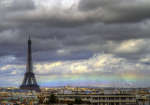 A Horizon Rainbow in Paris
27.03.2013
Why is this horizon so colorful? Because, opposite the Sun, it is raining. What is pictured above is actually just a common rainbow. It's uncommon appearance is caused by the Sun being unusually high in the sky during the rainbow's creation.
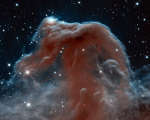 The Horsehead Nebula in Infrared from Hubble
22.04.2013
While drifting through the cosmos, a magnificent interstellar dust cloud became sculpted by stellar winds and radiation to assume a recognizable shape. Fittingly named the Horsehead Nebula, it is embedded in the vast and complex Orion Nebula (M42).
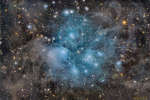 The Pleiades Deep and Dusty
25.02.2014
The well known Pleiades star cluster is slowly destroying part of a passing cloud of gas and dust. The Pleiades is the brightest open cluster of stars on Earth's sky and can be seen from almost any northerly location with the unaided eye.
|
January February March April May June July August September |
|||||||||||||||||||||||||||||||||||||||||||||||||