
|
You entered: Earth's atmosphere
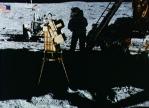 The First Lunar Observatory
10.11.2000
The first, and so far only, lunar astronomical observatory was deployed by the Apollo 16 crew in 1972. The Far Ultraviolet Camera / Spectrograph used a 3-inch diameter Schmidt telescope to photograph the Earth, nebulae, star clusters, and the Large Magellanic Cloud.
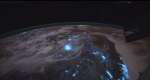 Flying Over the Earth at Night
31.03.2013
Many wonders are visible when flying over the Earth at night. A compilation of such visual spectacles was captured recently from the International Space Station (ISS) and set to rousing music. Passing below are white clouds, orange city lights, lightning flashes in thunderstorms, and dark blue seas.
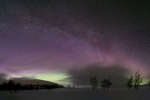 Sky Delights Over Sweden
15.04.2008
This night was a sky enthusiast's delight. While relaxing in Sweden last week, many a cosmic wonder was captured with a single snapshot. They are described here from near to far. In the foreground are nearby trees and more distant snow covered mountains.
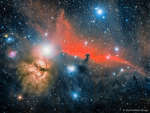 The Horsehead Nebula
15.12.2015
The Horsehead Nebula is one of the most famous nebulae on the sky. It is visible as the dark indentation to the red emission nebula in the center of the above photograph. The horse-head feature is dark because it is really an opaque dust cloud that lies in front of the bright red emission nebula.
 Blue Jet Lightning
11.11.1995
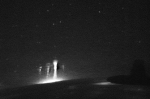
Recently two new types of lightning have been verified: red sprites and blue jets. These atmospheric discharges occur very high in the Earth's atmosphere - much higher than the familiar form of lightning. Blue jets appear blue in color and go from the tops of clouds to a height of about 50 kilometers.
 A Colorful Solar Corona over the Himalayas
10.01.2016
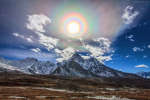
What are those colorful rings around the Sun? A corona visible only to Earth observers in the right place at the right time. Rings like this will sometimes appear when the Sun or Moon is seen through thin clouds.
 A Phoenix Aurora over Iceland
15.03.2016
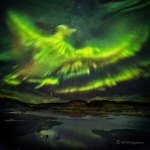
All of the other aurora watchers had gone home. By 3:30 am in Iceland, on a quiet night last September, much of that night's auroras had died down. Suddenly though, a new burst of particles streamed down from space, lighting up the Earth's atmosphere once again.
 The 220 Mirrors of CRTF
4.10.1999
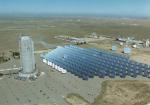
Even the largest of modern optical telescopes are small when compared with the light gathering power of the Central Receiver Test Facility (CRTF) located in New Mexico, USA. CRTF has 220 mirrors each over 7-meters in diameter all focused on a single tower.
 Blue Flash
8.01.2002
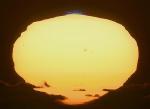
Difficult to observe, the momentary green flash above the rising or setting sun has been documented as a phenomenon caused by the atmospheric bending or refraction of sunlight. Like a weak prism, the Earth's atmosphere breaks white sunlight into colors, bending red colors slightly and green and blue colors through increasingly larger angles.
 Flying Over the Earth at Night
5.03.2012
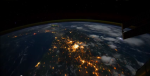
Many wonders are visible when flying over the Earth at night. A compilation of such visual spectacles was captured recently from the International Space Station (ISS) and set to rousing music. Passing below are white clouds, orange city lights, lightning flashes in thunderstorms, and dark blue seas.
|
January February March April May June July August September October |
|||||||||||||||||||||||||||||||||||||||||||||||||