
|
You entered: Ring Nebula
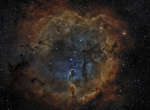 IC 1396: Emission Nebula in Cepheus
20.07.2017
Stunning emission nebula IC 1396 mixes glowing cosmic gas and dark dust clouds in the high and far off constellation of Cepheus. Energized by the bright central star seen here, this star forming region sprawls across hundreds of light-years, spanning over three degrees on the sky while nearly 3,000 light-years from planet Earth.
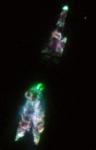 Emerging Planetary Nebula CRL 618
6.09.2000
CRL 618 may look to some like an Olympian declaring victory. Only a few hundred years ago, however, CRL 618 appeared as a relatively modest red giant star. Since then it has run out of core material to fuse and so has started to become a planetary nebula.
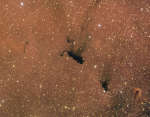 Molecular Cloud Barnard 163
1.05.2011
It may look to some like a duck, but it lays stars instead of eggs. In the center of the above image lies Barnard 163, a nebula of molecular gas and dust so thick that visible light can't shine through it.
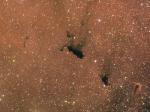 Molecular Cloud Barnard 163
21.03.2007
It may look to some like a duck, but it lays stars instead of eggs. In the center of the above image lies Barnard 163, a nebula of molecular gas and dust so thick that visible light can't shine through it.
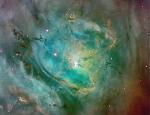 Stars and Dust of the Lagoon Nebula
8.09.2003
The large majestic Lagoon Nebula is home for many young stars and hot gas. Spanning 100 light years across while lying only about 5000 light years distant, the Lagoon Nebulae is so big and bright that it can be seen without a telescope toward the constellation of Sagittarius.
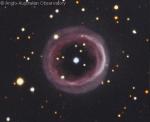 Shapley 1: An Annular Planetary Nebula
25.06.2000
What happens when a star runs out of nuclear fuel? The center condenses into a white dwarf while the outer atmospheric layers are expelled into space and appear as a planetary nebula. This particular planetary nebula, designated Shapley 1 after the famous astronomer Harlow Shapley, has a very apparent annular ring like structure.
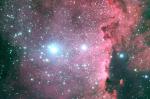 Hot Stars in the Southern Milky Way
7.05.1999
Hot blue stars, red glowing hydrogen gas, and dark, obscuring dust clouds are strewn through this dramatic region of the Milky Way in the southern constellation of Ara (the Altar). About 4,000 light-years from Earth, the stars at the left are young, massive, and energetic.
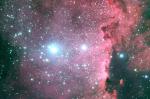 Hot Stars in the Southern Milky Way
22.12.2001
Hot blue stars, red glowing hydrogen gas, and dark, obscuring dust clouds are strewn through this dramatic region of the Milky Way in the southern constellation of Ara (the Altar). About 4,000 light-years from Earth, the stars at the left are young, massive, and energetic.
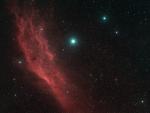 NGC 1499: California Nebula
10.03.2005
Drifting through the Orion Arm of the spiral Milky Way Galaxy, this cosmic cloud by chance echoes the outline of California on the west coast of the United States. Our own Sun also lies within the Milky Way's Orion Arm, only about 1,500 light-years from the California Nebula.
 The Dark River to Antares
16.05.2020
A dark river seems to flow through this sky from the horizon toward colorful clouds near red giant star Antares. Murky looking, the dark river is a dusty nebula obscuring background starlight near the central Milky Way, although the dark dust nebula contains mostly hydrogen molecular gas.
|
January February March April May June July August September October |
|||||||||||||||||||||||||||||||||||||||||||||||||