
|
You entered: cluster gas
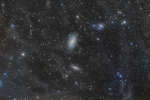 The M81 Galaxy Group Through the Integrated Flux Nebula
12.05.2008
Large galaxies and faint nebula highlight this deep image of the M81 Group of galaxies. First and foremost in the above wide-angle 12-hour exposure is the grand design spiral galaxy M81, the largest galaxy visible in the image.
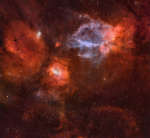 NGC 7635: Bubble in a Cosmic Sea
26.10.2017
Adrift in a cosmic sea of stars and glowing gas the delicate, floating apparition left of center in this widefield view is cataloged as NGC 7635, the Bubble Nebula. A mere 10 light-years wide, the tiny Bubble Nebula was blown by the winds of a massive star.
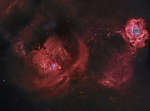 Field of Rosette
14.02.2010
What surrounds the florid Rosette nebula? To better picture this area of the sky, the famous flowery emission nebula on the far right has been captured recently in a deep and dramatic wide field image that features several other sky highlights.
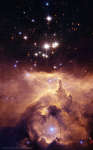 NGC 6357: Cathedral to Massive Stars
27.03.2016
How massive can a normal star be? Estimates made from distance, brightness and standard solar models had given one star in the open cluster Pismis 24 over 200 times the mass of our Sun, making it one of the most massive stars known.
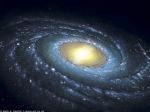 Milky Way Illustrated
4.01.2005
What does our Milky Way Galaxy look like from afar? Since we are stuck inside, and since opaque dust truncates our view in visible light, nobody knows for sure. Drawn above, however, is a good guess based on many different types of observations.
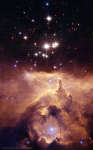 NGC 6357: Cathedral to Massive Stars
30.08.2020
How massive can a normal star be? Estimates made from distance, brightness and standard solar models had given one star in the open cluster Pismis 24 over 200 times the mass of our Sun, making it one of the most massive stars known.
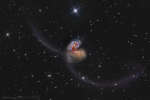 Exploring the Antennae
27.03.2021
Some 60 million light-years away in the southerly constellation Corvus, two large galaxies are colliding. Stars in the two galaxies, cataloged as NGC 4038 and NGC 4039, very rarely collide in the course of the ponderous cataclysm that lasts for hundreds of millions of years.
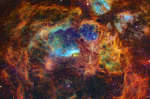 NGC 6357: The Lobster Nebula
28.10.2020
Why is the Lobster Nebula forming some of the most massive stars known? No one is yet sure. Cataloged as NGC 6357, the Lobster Nebula houses the open star cluster Pismis 24 near its center -- a home to unusually bright and massive stars.
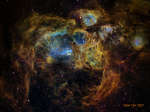 NGC 6357: The Lobster Nebula
26.12.2018
Why is the Lobster Nebula forming some of the most massive stars known? No one is yet sure. Cataloged as NGC 6357, the Lobster Nebula houses the open star cluster Pismis 24 near its center -- a home to unusually bright and massive stars.
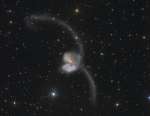 The Antennae
29.04.2011
Some 60 million light-years away in the southerly constellation Corvus, two large galaxies collided. But the stars in the two galaxies, cataloged as NGC 4038 and NGC 4039, don't collide in the course of the ponderous event, lasting hundreds of millions of years.
|
January February March April May June July August |
||||||||||||||||||||||||||||||||||||||||||||||||||||||||