
|
You entered: emission nebula
 APOD: 2025 April 28 Б Gum 37 and the Southern Tadpoles
27.04.2025
This cosmic skyscape features glowing gas and dark dust clouds alongside the young stars of NGC 3572. A beautiful emission nebula and star cluster, it sails far southern skies within the nautical constellation Carina.
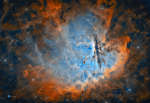 APOD: 2025 March 26 Б Star Formation in the Pacman Nebula
25.03.2025
You'd think the Pacman Nebula would be eating stars, but actually it is forming them. Within the nebula, a cluster's young, massive stars are powering the pervasive nebular glow. The eye-catching shapes...
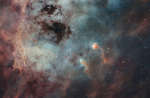 APOD: 2026 March 17 Б The Tadpoles of IC 410
16.03.2026
This telescopic close-up shows off the central regions of otherwise faint emission nebula IC 410, captured under backyard skies. Presented in a Hubble color palette, the image combines visible broadband and narrowband data with data from the near-infrared. Below and right of center are two remarkable inhabitants of the interstellar pond of gas and dust.
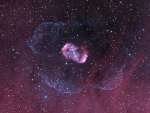 A Halo for NGC 6164
7.05.2009
Beautiful emission nebula NGC 6164 was created by a rare, hot, luminous O-type star, some 40 times as massive as the Sun. Seen at the center of the cosmic cloud, the star is a mere 3 to 4 million years old.
 APOD: 2025 March 11 Б NGC 1672: Barred Spiral Galaxy from Hubble
10.03.2025
Many spiral galaxies have bars across their centers. Even our own Milky Way Galaxy is thought to have a modest central bar. Prominently barred spiral galaxy NGC 1672, featured here, was captured in spectacular detail in an image taken by the orbiting Hubble Space Telescope.
 Encke and the Tadpoles
26.10.2023
History's second known periodic comet is Comet Encke (2P/Encke). As it swings through the inner Solar System, Encke's orbit takes it from an aphelion, its greatest distance from the Sun, inside the orbit of Jupiter to a perihelion just inside the orbit of Mercury.
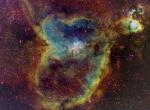 IC 1805: Light from the Heart
17.09.2004
Sprawling across hundreds of light-years, emission nebula IC 1805 is a mix of glowing interstellar gas and dark dust clouds. Only about 7,500 light-years away, stars were born in this region whose nickname - the Heart Nebula - derives from its suggestive shape (seen here sideways).
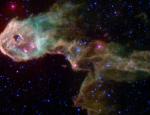 Inside The Elephant s Trunk
18.12.2003
Spectacular first images from the newly christened Spitzer Space Telescope include this penetrating interior view of an otherwise opaque dark globule known as the Elephant's Trunk Nebula. Seen in a composite of infrared...
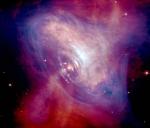 Composite Crab
4.09.2003
The Crab Pulsar, a city-sized, magnetized neutron star spinning 30 times a second, lies at the center of this composite image of the inner region of the well-known Crab Nebula. The spectacular picture combines...
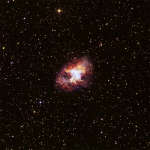 Cosmic Crab Nebula
25.07.2014
The Crab Pulsar, a city-sized, magnetized neutron star spinning 30 times a second, lies at the center of this tantalizing wide-field image of the Crab Nebula. A spectacular picture of one of our Milky Way's supernova remnants, it combines optical survey data with X-ray data from the orbiting Chandra Observatory.
|
January February March April May June July August September October |
|||||||||||||||||||||||||||||||||||||||||||||||||