
|
You entered: full moon
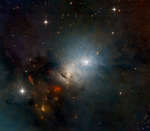 NGC 1333: Stellar Nursery in Perseus
10.11.2021
NGC 1333 is seen in visible light as a reflection nebula, dominated by bluish hues characteristic of starlight reflected by interstellar dust. A mere 1,000 light-years distant toward the heroic constellation Perseus, it lies at the edge of a large, star-forming molecular cloud.
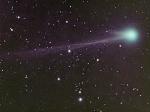 APOD: 2004 August 30- Announcing Comet C 2003 K4 LINEAR
30.08.2004
A comet discovered last year has brightened unexpectedly and now may become visible to the unaided eye within the next month. Designated Comet C/2003 K4 (LINEAR), the comet was discovered in 2003 May by project LINEAR.
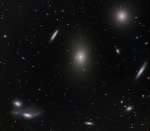 M86 in the Virgo Cluster
25.04.2008
Bright lenticular galaxy M86 is near center of this cosmic view, at the heart of the Virgo Galaxy Cluster. Other bright galaxies in the neighborhood include M84 at the upper right, edge-on spiral NGC4388...
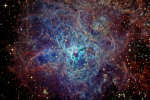 The Cosmic Web of the Tarantula Nebula
10.11.2008
First cataloged as a star, 30 Doradus is actually an immense star forming region in nearby galaxy The Large Magellanic Cloud. The region's spidery appearance is responsible for its popular name, the Tarantula nebula, except that this tarantula is about 1,000 light-years across, and 180,000 light-years away in the southern constellation Dorado.
 APOD: 2023 March 15 Б Jupiter and Venus Converge over Germany
14.03.2023
This was a sky to show the kids. Early this month the two brightest planets in the night sky, Jupiter and Venus, appeared to converge. At their closest, the two planets were separated by only about the angular width of the full moon.
 Messier 24: Sagittarius Star Cloud
27.06.2023
Unlike most entries in Charles Messier's famous catalog of deep sky objects, M24 is not a bright galaxy, star cluster, or nebula. It's a gap in nearby, obscuring interstellar dust clouds that allows a view of the distant stars in the Sagittarius spiral arm of our Milky Way galaxy.
 APOD: 2023 October 18 Б Dust and the Western Veil Nebula
17.10.2023
It's so big it is easy to miss. The entire Veil Nebula spans six times the diameter of the full moon, but is so dim you need binoculars to see it. The nebula was created about 15,000 years ago when a star in the constellation of the Swan (Cygnus) exploded.
 Spiral Galaxy NGC 6744
31.10.2024
Big, beautiful spiral galaxy NGC 6744 is nearly 175,000 light-years across, larger than our own Milky Way. It lies some 30 million light-years distant in the southern constellation Pavo but appears as only a faint smudge in the eyepiece of a small telescope.
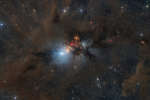 NGC 1333: Stellar Nursery in Perseus
29.01.2026
NGC 1333 is seen in visible light as a reflection nebula, dominated by bluish hues characteristic of starlight reflected by interstellar dust. A mere 1,000 light-years distant toward the heroic constellation Perseus, it lies at the edge of a large, star-forming molecular cloud.
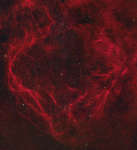 RCW 114: A Dragon s Heart in Ara
10.01.2018
Large and dramatically shaped, this cosmic cloud spans nearly 7 degrees or 14 full moons across planet Earth's sky toward the southern constellation Ara. Difficult to image, the filamentary apparition is cataloged as RCW 114 and traced in this telescopic mosaic by the telltale reddish emission of ionized hydrogen atoms.
|
January February March April May June July August September October |
|||||||||||||||||||||||||||||||||||||||||||||||||