
|
You entered: hot star
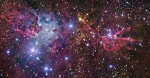 Fox Fur, a Unicorn, and a Christmas Tree
25.12.2008
Clouds of glowing hydrogen gas fill this colorful skyscape in the faint but fanciful constellation Monoceros, the Unicorn. A star forming region cataloged as NGC 2264, the complex jumble of cosmic gas and dust...
 Orion and the Running Man
13.11.2025
Few cosmic vistas can excite the imagination like The Great Nebula in Orion. Visible as a faint, bland celestial smudge to the naked-eye, the nearest large star-forming region sprawls across this sharp colorful telescopic image. Designated M42 in the Messier Catalog, the Orion Nebula's glowing gas and dust surrounds hot, young stars.
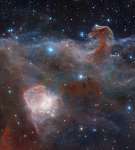 Horsehead: A Wider View
3.05.2013
Combined image data from the massive, ground-based VISTA telescope and the Hubble Space Telescope was used to create this wide perspective of the interstellar landscape surrounding the famous Horsehead Nebula. Captured at near-infrared wavelengths...
 APOD: 2023 August 22 Б The Pistachio Nebula
22.08.2023
This nebula had never been noted before. Newly discovered nebulas are usually angularly small and found by professionals using large telescopes. In contrast, the Pistachio Nebula was discovered by dedicated amateurs and, although faint, is nearly the size of the full Moon.
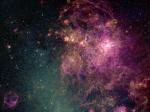 30 Doradus: The Tarantula Zone
12.12.2005
The Tarantula Nebula is more than 1,000 light-years across - a giant emission nebula within our neighboring galaxy the Large Magellanic Cloud. Inside this cosmic arachnid lies a central young cluster of massivestars, cataloged as R136, whose intense radiation and strong winds have helped energize the nebular glow and shape the spidery filaments.
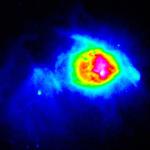 Hydrogen Blob N88A in the Small Magellanic Cloud
29.07.1999
The bright blob of hydrogen gas cataloged as N88A is seen at the right. It measures a mere 3 light years across. Emerging from the cool, dusty interstellar medium in a nearby irregular galaxy known as the Small Magellanic Cloud, N88A hides hot young stars at its core.
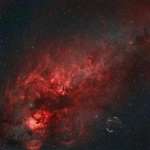 Nebulae in the Northern Cross
19.11.2010
Explore a beautiful and complex region of nebulae strewn along the plane of our Milky Way Galaxy in this widefield skyscape. The image emphasizes cosmic gas clouds in a 25 by 25 degree view centered on the Northern Cross, the famous asterism in the constellation Cygnus.
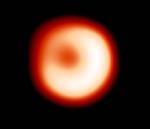 LkHa101: The Hole in the Doughnut
2.03.2001
You'd need a really big cup of coffee with this doughnut ... because the hole in the middle is about a billion kilometers across. Centered on the Sun, a circle that size would lie between the orbits of Mars and Jupiter.
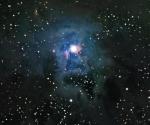 NGC 7023: The Iris Nebula
14.12.2001
Like delicate cosmic petals, these clouds of interstellar dust and gas have blossomed 1,300 light-years away in the fertile star fields of the constellation Cepheus. Sometimes called the Iris Nebula and dutifully cataloged as NGC 7023, this is not the only nebula in the sky to evoke the imagery of flowers.
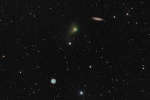 The Comet, the Owl, and the Galaxy
21.04.2016
Comet C/2014 S2 (PanSTARRS) poses for a Messier moment in this telescopic snapshot from April 18. In fact it shares the 1.5 degree wide field-of-view with two well-known entries in the 18th century comet-hunting astronomer's famous catalog.
|
January February March April May June July |
|||||||||||||||||||||||||||||||||||||||||||||||||