
|
You entered: ring galaxy
 APOD: 2025 November 19 Б Chamaeleon Dark Nebulas
19.11.2025
Sometimes the dark dust of interstellar space has an angular elegance. Such is the case toward the far-south constellation of Chamaeleon. Normally too faint to see, dark dust is best known for blocking visible light from stars and galaxies behind it.
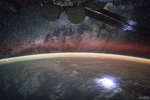 Space Station Vista: Planet and Galaxy
18.01.2017
If you could circle the Earth aboard the International Space Station, what might you see? Some amazing vistas, one of which was captured in this breathtaking picture in mid-2015. First, visible at the top, are parts of the space station itself including solar panels.
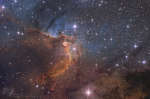 SH2 155: The Cave Nebula
5.11.2014
This colorful skyscape features the dusty Sharpless catalog emission region Sh2-155, the Cave Nebula. In the composite image, data taken through narrowband filters tracks the glow of ionized sulfur, hydrogen, and oxygen atoms in red, green, and blue hues.
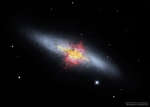 The Central Magnetic Field of the Cigar Galaxy
11.03.2019
Are galaxies giant magnets? Yes, but the magnetic fields in galaxies are typically much weaker than on Earth's surface, as well as more complex and harder to measure. Recently, though, the HAWC+ instrument...
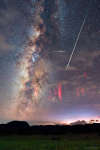 Perseid Meteor, Red Sprites, and Nova RS Oph
16.08.2021
This was an unusual sky. It wasn't unusual because of the central band the Milky Way Galaxy, visible along the image left. Most dark skies show part of the Milky Way. It wasn't unusual because of the bright meteor visible on the upper right.
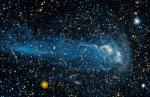 The Tail of a Wonderful Star
17.08.2007
To seventeenth century astronomers, Omicron Ceti or Mira was known as a wonderful star, a star whose brightness could change dramatically in the course of about 11 months. Mira is now seen as the archetype of an entire class of long-period variable stars.
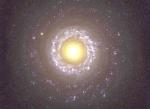 Spiral Galaxy NGC 7742
1.07.2001
This might resemble a fried egg you've had for breakfast, but it's actually much larger. In fact, ringed by blue-tinted star forming regions and faintly visible spiral arms, the yolk-yellow center of this face-on spiral galaxy, NGC 7742, is about 3,000 light-years across.
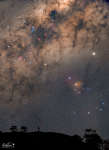 The Galaxy Above
15.10.2019
Have you contemplated your home galaxy lately? If your sky looked like this, perhaps you'd contemplate it more often! The featured picture is actually a composite of two images taken last month from the same location in south Brazil and with the same camera -- but a few hours apart.
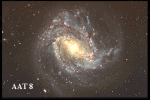 Spiral Galaxy M83
19.04.1997
The long winding arms of this nearby spiral galaxy define it as the "Southern Pinwheel." But M83 is quite a typical spiral - much like our own Milky Way Galaxy. Spiral galaxies contains many billions of stars, the youngest of which inhabit the spiral arms and glow strongly in blue light.
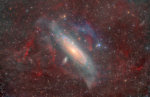 APOD: 2026 June 3 Б Andromeda Through Gas and Dust
3.06.2026
Over 1000 years ago, Persian astronomer Abd al-Rahman al-Sufi published humanityБs oldest known record of the Andromeda Galaxy in "The Book of Fixed Stars" (Bodleian Library MS. Marsh 144 p. 167). 800 years later, Andromeda became the 31st entry in Charles MessierБs "Catalogue of Nebulae and Star Clusters".
|
January February March April May June July August September October |
|||||||||||||||||||||||||||||||||||||||||||||||||