
|
You entered: NASA
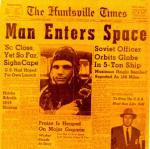 Man Enters Space
14.04.2001
Forty years ago, on April 12, 1961, Soviet cosmonaut Yuri Alexseyevich Gagarin became the first human in space. His remotely controlled Vostok 1 spacecraft lofted him to an altitude of 200 miles and carried him once around planet Earth. Gagarin was strictly a passenger on this flight.
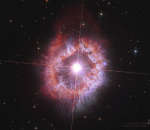 The Outburst Clouds of Star AG Car
26.05.2021
What created these unusual clouds? At the center of this 2021 Hubble image sits AG Carinae, a supergiant star located about 20,000 light-years away in the southern constellation Carina. The star's emitted...
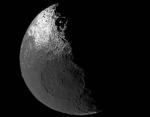 Dark Terrain on Saturn s Iapetus
3.01.2006
Why are vast sections of Iapetus as dark as coal? No one knows for sure. Iapetus, the third largest moon of Saturn, was inspected again as the Saturn-orbiting robot Cassini spacecraft swooped past the enigmatic world again late last year.
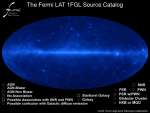 Fermi Catalogs the Gamma ray Sky
18.03.2010
What shines in the gamma-ray sky? The most complete answer yet to that question is offered by the Fermi Gamma-ray Space Telescope's first all-sky catalog. Fermi's sources of cosmic gamma-rays feature nature...
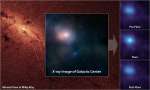 The Black Hole in the Milky Way
2.11.2012
At the center of our Milky Way Galaxy, a mere 27,000 light-years away, lies a black hole with 4 million times the mass of the Sun. Fondly known as Sagittarius A* (pronounced A-star)...
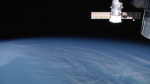 A Live View from the International Space Station
14.05.2014
If were floating above the Earth right now, this is what you might see. Two weeks ago, the robotic SpaceX Dragon capsule that delivered supplies to the Earth-orbiting International Space Station (ISS) also delivered High Definition Earth Viewing (HDEV) cameras that take and transmit live views of Earth.
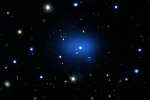 JKCS041: The Farthest Galaxy Cluster Yet Measured
28.10.2009
What if we could see back to the beginning of the universe? We can -- since it takes the age of the universe for light to cross the universe. Peering at distant objects, therefore, tells us about how the universe used to be, even near its beginning.
 Earth Nears Asteroid Toutatis
20.01.1997
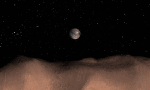
On November 29, 1996 the Earth came within 3.3 million miles of the asteroid Toutatis. Above is a computer simulated picture of this spectacle from the surface of Toutatis (a 2.5 degree field of view looking toward Earth). In Earth's sky, Toutatis appeared only as a faint object moving against a background of stars.
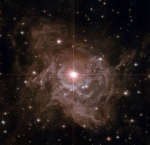 Nearby Cepheid Variable RS Pup
9.09.2013
It is one of the most important stars in the sky. This is partly because, by coincidence, it is surrounded by a dazzling reflection nebula. Pulsating RS Puppis, the brightest star in the image center, is some ten times more massive than our Sun and on average 15,000 times more luminous.
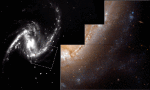 Hubble's Constant And The Expanding Universe (I)
13.05.1996
Our Universe is expanding. Distant galaxies appear to recede from us at ever-increasing speeds. What is the rate of expansion? How long has it been expanding? What will be its ultimate fate? Two groups of astronomers are searching vigorously for answers to these fundamental questions using the Hubble Space Telescope (HST).
|
January February March April May June July August September October |
|||||||||||||||||||||||||||||||||||||||||||||||||