
|
You entered: star
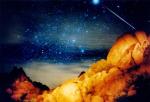 A Sirius Leonid Meteor
18.11.1999
In the sky or on the web, did you watch this year's Leonid meteor shower? If you did, meteors flashing through the night sky should be a familiar sight. Recorded last year during...
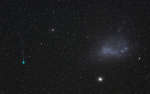 Sweeping Through Southern Skies
16.02.2013
For now, Comet Lemmon (C/2012 F6a), and Comet PanSTARRS (C/2011 L4) are sweeping through southern skies. Lemmon's lime green coma and thin tail are near the left edge of this telephoto scene, a single frame from a timelapse video (vimeo here) recorded on February 12, tracking its motion against the background stars.
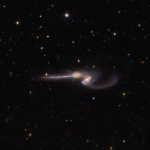 NGC 4676: The Mighty Mice
14.06.2019
These two mighty galaxies are pulling each other apart. Known as The Mice because they have such long tails, each large spiral galaxy has actually passed through the other. Their long tails are drawn out by strong gravitational tides rather than collisions of their individual stars.
 APOD: 2025 August 29 Б A Dark Veil in Ophiuchus
29.08.2025
The diffuse hydrogen-alpha glow of emission region Sh2-27 fills this cosmic scene. The field of view spans nearly 3 degrees across the nebula-rich constellation Ophiuchus toward the central Milky Way. A Dark Veil...
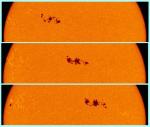 Sunspot Region 30
18.07.2002
The solar active region designated number 0030 is now appearing on the visible hemisphere of the closest star. Dwarfed by the Sun's disk, the group of sunspots which make up region 30 actually cover an enormous area -- nearly 10 times the size of Earth.
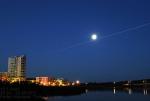 Moons and Bright Mars
1.08.2003
In this serene view, the moons of Earth along with the bright planet Mars shine above the city of Turku near the southwestern tip of Finland. Of course Earth's large natural satellite, the Moon, at a distance of 400,000 kilometers, is by far the brightest object in this sky.
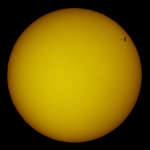 Station and Shuttle Transit the Sun
23.05.2010
That's no sunspot. On the upper right of the above image of the Sun, the dark patches are actually the International Space Station (ISS) and the Space Shuttle Atlantis on mission STS-132.
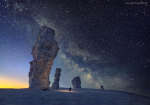 The Milky Way over the Seven Strong Men Rock Formations
25.01.2015
You may have heard of the Seven Sisters in the sky, but have you heard about the Seven Strong Men on the ground? Located just west of the Ural Mountains, the unusual Manpupuner rock formations are one of the Seven Wonders of Russia. How these ancient 40-meter high pillars formed is yet unknown.
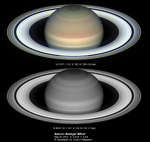 Saturn at Opposition
29.05.2015
Telescopic observers on Earth have been treated to spectacular views of Saturn lately as the ringed planet reached its 2015 opposition on May 23 at 0200 UT. Of course opposition means opposite the Sun in Earth's sky. So near opposition Saturn is up all night, at its closest and brightest for the year.
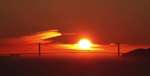 Golden Gate Sunset: Green Flash
2.12.2015
The setting is San Francisco Bay, the time is sunset, and the bridge is the Golden Gate. What you are about to see is an unexpected double sunset ending with a rare green flash.
|
January February March April May June July August September October |
|||||||||||||||||||||||||||||||||||||||||||||||||