
|
You entered: Earth
 A Picturesque Venus Transit
3.06.2012
The rare transit of Venus across the face of the Sun in 2004 was one of the better-photographed events in sky history. Both scientific and artistic images flooded in from the areas that could see the transit: Europe and much of Asia, Africa, and North America.
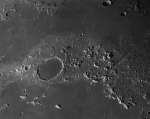 Plato and the Lunar Alps
3.12.2014
The dark-floored, 95 kilometer wide crater Plato and sunlit peaks of the lunar Alps (Montes Alpes) are highlighted in this sharp digital snapshot of the Moon's surface. While the Alps of planet Earth...
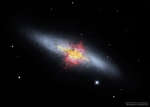 The Central Magnetic Field of the Cigar Galaxy
11.03.2019
Are galaxies giant magnets? Yes, but the magnetic fields in galaxies are typically much weaker than on Earth's surface, as well as more complex and harder to measure. Recently, though, the HAWC+ instrument...
 APOD: 2023 October 1 Б A Desert Eclipse
1.10.2023
A good place to see a ring-of-fire eclipse, it seemed, would be from a desert. In a desert, there should be relatively few obscuring clouds and trees. Therefore late December of 2019, a group...
 Comet Olbers over Kunetice Castle
1.08.2024
A visitor to the inner solar system every 70 years or so Comet 13P/Olbers reached its most recent perihelion, or closest approach to the Sun, on June 30 2024. Now on a return voyage...
 APOD: 2025 February 18 Б Thors Helmet versus the Seagull
18.02.2025
Seen as a seagull and a duck, these nebulae are not the only cosmic clouds to evoke images of flight. But both are winging their way across this broad celestial landscape, spanning almost 7 degrees across planet Earth's night sky toward the constellation of the Big Dog (Canis Major).
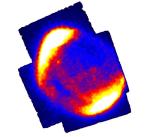 SN 1006: Pieces of the Cosmic Ray Puzzle
2.12.2000
Research balloon flights conducted in 1912 by Austrian physicist Victor Hess revealed that the Earth was constantly bombarded by high energy radiation from space - which came to be called "Cosmic Rays". What are Cosmic Rays and where do they come from?
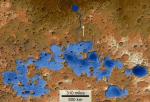 Carving Ma adim Vallis
27.06.2002
Just as erosion from the Colorado River carved the Grand Canyon on Earth, a river of flood water may have carved Ma'adim Vallis, one of the largest canyons on Mars. Researchers have presented...
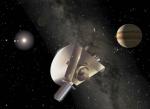 New Horizons at Jupiter
4.12.2003
Headed for the first close-up exploration of the Pluto-Charon system and the icy denizens of the Kuiper belt, NASA's New Horizons spacecraft is pictured here in an artist's vision of the robot probe outward bound.
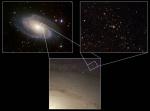 Supernova Survivor
12.02.2004
Beginning with a full view of beautiful spiral galaxy M81, follow the insets (left, bottom, then right) to zoom in on a real survivor. Seen at the center of the final field on the right is a star recently identified as the survivor of a cosmic cataclysm -- the supernova explosion of its companion star.
|
January February March April May June July August September October |
|||||||||||||||||||||||||||||||||||||||||||||||||