
|
You entered: star
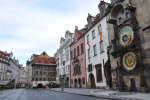 The Prague Astronomical Clock
7.11.2017
In the center of Prague there's a clock the size of a building. During the day, crowds gather to watch the show when it chimes in a new hour. The Prague Astronomical Clock...
 Fear and Dread: The Moons of Mars
30.10.2020
On Halloween fear and dread will stalk your night skies, also known as Phobos and Deimos the moons of Mars. The 2020 opposition of Mars was on October 13, so the Red Planet will still rise shortly after sunset.
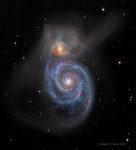 M51: The Whirlpool Galaxy
2.09.2021
Find the Big Dipper and follow the handle away from the dipper's bowl until you get to the last bright star. Then, just slide your telescope a little south and west and you'll come upon this stunning pair of interacting galaxies, the 51st entry in Charles Messier's famous catalog.
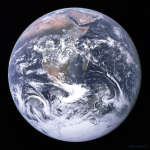 Blue Marble Earth
6.02.2022
Welcome to planet Earth, the third planet from a star named the Sun. The Earth is shaped like a sphere and composed mostly of rock. Over 70 percent of the Earth's surface is water. The planet has a relatively thin atmosphere composed mostly of nitrogen and oxygen.
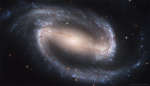 Barred Spiral Galaxy NGC 1300
16.10.2022
Across the center of this spiral galaxy is a bar. And at the center of this bar is smaller spiral. And at the center of that spiralбis a supermassiveбblack hole.б This all happens...
 Structure in the Tail of Comet 12P/Pons Brooks
16.02.2024
Heading for its next perihelion passage on April 21, Comet 12P/Pons-Brooks is growing brighter. The greenish coma of this periodic Halley-type comet has become relatively easy to observe in small telescopes. But the bluish...
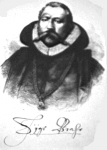 Tycho Brahe Measures the Sky
7.01.2001
Tycho Brahe was the most meticulous astronomical observer of his time. Brahe, who lived between 1546 and 1601, set out to solve the day's most pressing astronomical problem: to determine whether the Earth or the Sun was at the center of the Solar System.
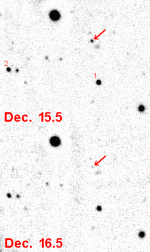 Gamma-ray Burster
18.12.1997
Gamma-ray bursts seem to be the most powerful explosions in the Universe. Yet their sources continue to elude researchers who stand in awe and frustration at the bursts' transient, enigmatic behavior. The blinking gif above illustrates the latest hard-won result in the quest to identify and understand the nature of the bursters.
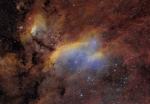 IC 4628: The Prawn Nebula
20.10.2006
South of Antares, in the tail of the nebula-rich constellation Scorpius, lies emission nebula IC 4628. Nearby hot, massive stars, millions of years young, radiate the nebula with invisible ultraviolet light, stripping electrons from atoms. The electrons eventually recombine with the atoms to produce the visible nebular glow.
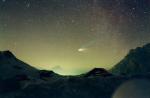 Comet Hale-Bopp Over Val Parola Pass
8.08.1999
Comet Hale-Bopp became much brighter than any surrounding stars. It was seen even over bright city lights. Out away from city lights, however, it put on quite a spectacular show. Here Comet Hale-Bopp was photographed above Val Parola Pass in the Dolomite mountains surrounding Cortina d'Ampezzo, Italy.
|
January February March April May June July August September October |
|||||||||||||||||||||||||||||||||||||||||||||||||