
|
You entered: Earth orbit
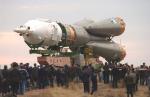 Rollout of a Soyuz TMA 2 Rocket
28.04.2003
It takes a big rocket to go into space. Last weekend, this huge Russian rocket was launched toward Earth-orbiting International Space Station (ISS), carrying two astronauts who will make up the new Expedition 7 crew.
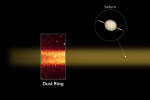 Giant Dust Ring Discovered Around Saturn
13.10.2009
What has created a large dust ring around Saturn? At over 200 times the radius of Saturn and over 50 times the radius of Saturn's expansive E ring, the newly discovered dust ring is the largest planetary ring yet imaged. The ring was found in infrared light by the Earth-orbiting Spitzer Space Telescope.
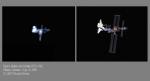 Space Station and Space Shuttle: Backyard View
12.10.2001
Knowing when and where to look, many enthusiastic sky gazers have been able to spot the International Space Station (ISS) as a bright star streaking through the twilight. But with a digital camera and a small telescope, recognizable images are possible too.
 APOD: 2025 February 26 Б Einstein Ring Surrounds Nearby Galaxy Center
26.02.2025
Do you see the ring? If you look very closely at the center of the featured galaxy NGC 6505, a ring becomes evident. It is the gravity of NGC 6505, the nearby (z = 0.042)...
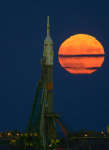 Soyuz vs Supermoon
17.11.2016
Faster than a speeding bullet, more powerful than a locomotive, and able to leap tall buildings in a single bound, this Soyuz rocket stands on the launch pad at Baikonur Cosmodrome in Kazakhstan on November 14.
 Sky Full of SARs
17.08.2024
On August 11 a Rocket Lab Electron rocket launched from a rotating planet. With a small satellite on board its mission was dubbed A Sky Full of SARs (Synthetic Aperture Radar satellites), departing for low Earth orbit from Mahia Peninsula on New Zealand's north island.
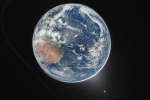 APOD: 2026 April 4 Б Hello World
4.04.2026
From pole to pole our fair planet is captured in this snapshot from space, an evocative image from a window of the Orion spacecraft Integrity. From the spacecraft's perspective the Sun is moving behind Earth's bright limb along the lower right.
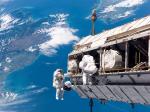 Upgrading the International Space Station
25.12.2006
The International Space Station (ISS) will be the largest human-made object ever to orbit the Earth. The station is so large that it could not be launched all at once -- it is being built piecemeal with large sections added continually by flights of the Space Shuttle.
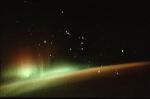 Aurora and Orion
20.03.1999
Looking toward the south from low Earth orbit, the crew of the Space Shuttle Endeavor made this stunning time exposure of the Aurora Australis or southern lights in April of 1994. Aurora are visible at high northern latitudes as well, with the northern lights known as Aurora Borealis.
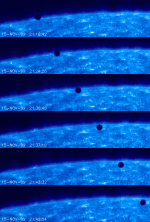 Mercury And The Sun
19.11.1999
Just days before the peak of the Leonid meteor shower, skywatchers were offered another astronomical treat as planet Mercury crossed the face of the Sun on November 15. Viewed from planet Earth, a transit of Mercury is not all that rare. The last occurred in 1993 and the next will happen in 2003.
|
January February March April May June July August September October |
|||||||||||||||||||||||||||||||||||||||||||||||||