
|
You entered: Moon
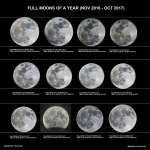 A Year of Full Moons
5.11.2017
Do all full moons look the same? No. To see the slight differences, consider this grid of twelve full moons. From upper left to lower right, the images represent every lunation from 2016 November through 2017 October, as imaged from Pakistan.
 Bats And The Barren Moon
31.10.1998
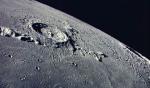
This picture, taken as the Apollo 17 astronauts orbited the Moon in 1972, depicts the stark lunar surface around the Eratosthenes and Copernicus craters. Images of a Moon devoid of life are familiar to denizens of the space age.
 Moon Meets Mercury
9.05.2008
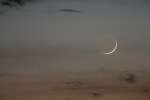
On Tuesday, May 6, while standing on planet Earth and sweeping your binoculars along the western horizon just after sunset, you might have encountered this arresting skyscape. The view features a slender crescent Moon and bright planet Mercury separated on the sky by only about 2 degrees.
 To the Moon
24.02.2024
Intuitive Machines' robotic lander Odysseus has accomplished the first U.S. landing on the Moon since the Apollo 17 mission in 1972. Launched on a SpaceX rocket on February 15, the phone booth sized lander reached lunar orbit on the 21st and touched down on the lunar surface at 6:23 pm ET on February 22nd.
 Analemma of the Moon
13.07.2005
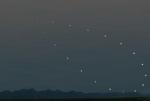
An analemma is that figure-8 curve you get when you mark the position of the Sun at the same time each day for one year. But the trick to imaging an analemma...
 Moon And Venus Share The Sky
28.07.2000
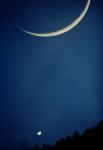
July is drawing to a close and in the past few days, some early morning risers could have looked east and seen a crescent Moon sharing the pre-dawn skies with planets Jupiter and Saturn.
 The Earth-Moon System
29.06.1995
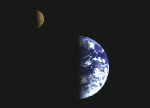
A double planet? From 4 million miles away on December 16, 1992, NASA's robot spacecraft Galileo took this picture of the Earth-moon system. The bright, sunlit half of the Earth contrasts strongly with the darker subdued colors of the moon. Our moon is one of the largest moons in the solar system.
 Full Moon, Full Mars
15.12.2022
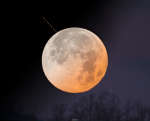
On December 8 a full Moon and a full Mars were close, both bright and opposite the Sun in planet Earth's sky. In fact Mars was occulted, passing behind the Moon when viewed from some locations across Europe and North America.
 Eclipsed Moon in Infrared
15.09.2001
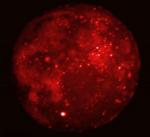
The total lunar eclipse of September 1996 disappointed many observers in North America who were cursed with cloudy skies. However, the Midcourse Space Experiment (MSX) satellite had a spectacular view from Earth orbit and SPIRIT III, an onboard infrared telescope, was used to repeatedly image the moon during the eclipse.
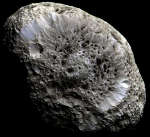 Saturns Hyperion: A Moon with Odd Craters
18.01.2009
What lies at the bottom of Hyperion's strange craters? Nobody knows. To help find out, the robot Cassini spacecraft now orbiting Saturn swooped past the sponge-textured moon in late 2005 and took an image of unprecedented detail.
|
January February March April May June July August September October |
|||||||||||||||||||||||||||||||||||||||||||||||||