
|
You entered: cluster gas
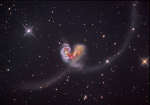 The Antennae
7.05.2010
Some 60 million light-years away in the southerly constellation Corvus, two large galaxies collided. But the stars in the two galaxies cataloged as NGC 4038 and NGC 4039 don't collide in the course of the ponderous, billion year or so long event.
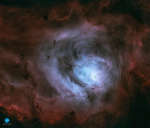 The Lagoon Nebula without Stars
8.08.2022
Ridges of glowing interstellar gas and dark dust clouds inhabit the turbulent, cosmic depths of the Lagoon Nebula. Also known as M8, the bright star forming region is about 5,000 light-years distant.
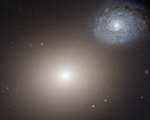 Elliptical M60, Spiral NGC 4647
28.01.2016
Giant elliptical galaxy M60 and spiral galaxy NGC 4647 do look like an odd couple in this sharp cosmic portrait from the Hubble Space Telescope. But they are found in a region of space where galaxies tend to gather, on the eastern side of the nearby Virgo Galaxy Cluster.
 Elliptical M60, Spiral NGC 4647
14.09.2012
Giant elliptical galaxy M60 and spiral galaxy NGC 4647 do look like an odd couple in this sharp cosmic portrait from the Hubble Space Telescope. But they are found in a region of space where galaxies tend to gather, on the eastern side of the nearby Virgo Galaxy Cluster.
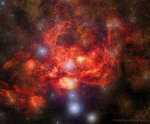 NGC 6357: The Lobster Nebula
1.11.2022
Why is the Lobster Nebula forming some of the most massive stars known? No one is yet sure. Cataloged as NGC 6357, the Lobster Nebula houses the open star cluster Pismis 24 near its center -- a home to unusually bright and massive stars.
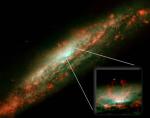 The Bubbling Cauldron of NGC 3079
22.08.2001
Edge-on spiral galaxy NGC 3079 is a mere 50 million light-years away toward the constellation Ursa Major. Shown in this stunning false-color Hubble Space Telescope image, the galaxy's disk - composed of spectacular star clusters in winding spiral arms and dramatic dark lanes of dust - spans some 70,000 light-years.
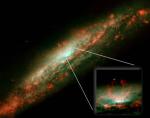 The Bubbling Cauldron of NGC 3079
16.10.2004
Edge-on spiral galaxy NGC 3079 is a mere 50 million light-years away toward the constellation Ursa Major. Shown in this stunning false-color Hubble Space Telescope image, the galaxy's disk - composed of spectacular star clusters in winding spiral arms and dramatic dark lanes of dust - spans some 70,000 light-years.
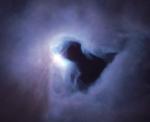 NGC 1999: Reflection Nebula In Orion
2.03.2000
A dusty bright nebula contrasts dramatically with a dusty dark nebula in this Hubble Space Telescope image recorded shortly after December's orbital servicing mission. The nebula, cataloged as NGC 1999, is a reflection nebula, which shines by reflecting light from a nearby star.
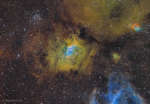 NGC 7635: Bubble in a Cosmic Sea
23.11.2016
Do you see the bubble in the center? Seemingly adrift in a cosmic sea of stars and glowing gas, the delicate, floating apparition in this widefield view is cataloged as NGC 7635 - The Bubble Nebula.
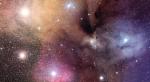 The Colorful Clouds of Rho Ophiuchi
2.06.2004
The many spectacular colors of the Rho Ophiuchi (oh'-fee-yu-kee) clouds highlight the many processes that occur there. The blue regions shine primarily by reflected light. Blue light from the star Rho Ophiuchi and nearby stars reflects more efficiently off this portion of the nebula than red light.
|
January February March April May June July August |
||||||||||||||||||||||||||||||||||||||||||||||||||||||||