
|
You entered: dust lanes
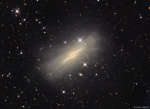 The Edge On Spindle Galaxy
25.07.2018
What kind of celestial object is this? A relatively normal galaxy -- but seen from its edge. Many disk galaxies are actually just as thin as NGC 5866, pictured here, but are not seen edge-on from our vantage point. A perhaps more familiar galaxy seen edge-on is our own Milky Way Galaxy.
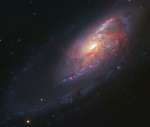 The Arms of M106
6.02.2013
The spiral arms of bright galaxy M106 sprawl through this remarkable multiframe portrait, composed of data from ground- and space-based telescopes. Also known as NGC 4258, M106 can be found toward the northern constellation Canes Venatici. The well-measured distance to M106 is 23.5 million light-years, making this cosmic scene about 80,000 light-years across.
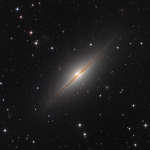 NGC 7814: Little Sombrero with Supernova
22.07.2021
Point your telescope toward the high flying constellation Pegasus and you can find this expanse of Milky Way stars and distant galaxies. NGC 7814 is centered in the pretty field of view that would almost be covered by a full moon.
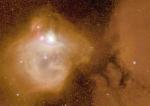 New Stars Destroying NGC 1748
3.04.2001
NGC 1748 cannot contain all the new stars it has formed. The young stars, the most massive of which are bright blue, emit so much energy they are pushing out and dispersing the gas and dust that comprise this star forming nebula.
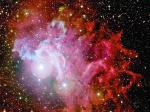 The Flaming Star Nebula from CFHT
28.02.2006
Rippling dust and gas lanes give the Flaming Star Nebula its name. The red and purple colors of the nebula are present in different regions and are created by different processes. The bright star...
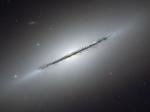 Edge On Galaxy NGC 5866
12.06.2006
Why is this galaxy so thin? Many disk galaxies are actually just as thin as NGC 5866, pictured above, but are not seen edge-on from our vantage point. One galaxy that is situated edge-on is our own Milky Way Galaxy.
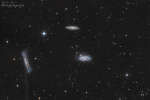 The Leo Trio
18.04.2019
This group is popular in the northern spring. Famous as the Leo Triplet, the three magnificent galaxies gather in one field of view. Crowd pleasers when imaged with even modest telescopes, they can be introduced individually as NGC 3628 (left), M66 (bottom right), and M65 (top).
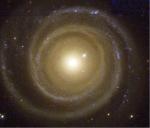 The Spiral Arms of NGC 4622
21.02.2004
While stirring a morning cup of coffee and thinking cosmic thoughts many astronomers would glance at this Hubble Space Telescope image of spiral galaxy NGC 4622 and assume that the galaxy was rotating counterclockwise in the picture.
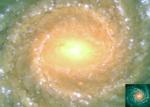 Spiral Galaxy NGC 1232
30.09.1998
Galaxies are fascinating not only for what is visible, but for what is invisible. Grand spiral galaxy NGC 1232, recently captured in detail by the new Very Large Telescope, is a good example.
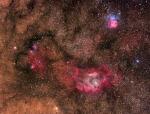 Sagittarius Triplet
14.06.2006
These three bright nebulae are often featured in telescopic tours of the constellation Sagittarius and the crowded starfields of the central Milky Way. In fact, 18th century cosmic tourist Charles Messier cataloged two of them; M8, the nebula below and right of center, and colorful M20 at the upper right.
|
January February March April May June July August September |
|||||||||||||||||||||||||||||||||||||||||||||||||