
|
You entered: hot star
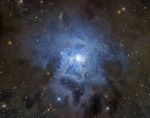 NGC 7023: The Iris Nebula
3.09.2021
These cosmic clouds have blossomed 1,300 light-years away, in the fertile starfields of the constellation Cepheus. Called the Iris Nebula, NGC 7023 is not the only nebula to evoke the imagery of flowers.
 NGC 7023: The Iris Nebula
2.09.2023
These cosmic clouds have blossomed 1,300 light-years away in the fertile starfields of the constellation Cepheus. Called the Iris Nebula, NGC 7023 is not the only nebula to evoke the imagery of flowers.
 NGC 7023: The Iris Nebula
25.07.2024
These cosmic clouds have blossomed 1,300 light-years away in the fertile starfields of the constellation Cepheus. Called the Iris Nebula, NGC 7023 is not the only nebula to evoke the imagery of flowers.
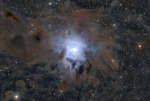 NGC 7023: The Iris Nebula
16.01.2026
These cosmic clouds have blossomed 1,300 light-years away in the fertile starfields of the constellation Cepheus. Called the Iris Nebula, NGC 7023 is not the only nebula to evoke the imagery of flowers.
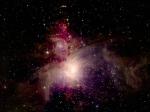 Orion Nebula: The 2MASS View
12.06.1998
Few astronomical sights excite the imagination like the nearby stellar nursery known as the Orion Nebula. The Nebula's glowing gas surrounds hot young stars at the edge of an immense interstellar molecular cloud only 1,500 light-years away.
 APOD: 2025 July 5 Б Ou4: The Giant Squid Nebula
5.07.2025
Difficult to capture, this mysterious, squid-shaped interstellar cloud spans nearly three full moons in planet Earth's sky. Discovered in 2011 by French astro-imager Nicolas Outters, the Squid Nebula's bipolar shape is distinguished here by the telltale blue emission from doubly ionized oxygen atoms.
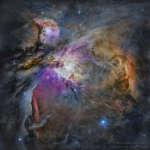 Orion Nebula: The Hubble View
29.06.2021
Few cosmic vistas excite the imagination like the Orion Nebula. Also known as M42, the nebula's glowing gas surrounds hot young stars at the edge of an immense interstellar molecular cloud only 1,500 light-years away.
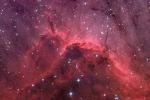 IC 5067: Emission Nebula Close up
27.12.2006
This amazing skyscape lies along a bright ridge of emission in IC 5067, also known as The Pelican Nebula. Appropriately, the Pelican Nebula itself is part of a much larger, complex star-forming region about 2,000 light-years away in the high flying constellation Cygnus, the Swan.
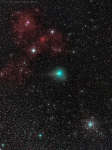 A Charioteer s Comet
1.03.2019
Still racing across planet Earth's night skies, Comet Iwamoto (C/2018 Y1) shares this pretty telescopic field of view with stars and nebulae of northern constellation Auriga, the Charioteer. Captured on February 27, Iwamoto's greenish coma and faint tail appear between a complex of reddish emission nebulae and open star cluster M36 (bottom right).
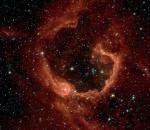 RCW 79: Stars in a Bubble
15.04.2005
A cosmic bubble of gas and dust, RCW 79 has grown to about 70 light-years in diameter, blown by the winds and radiation from hot young stars. Infrared light from the dust embedded in the nebula is tinted red in this gorgeous false-color view from the Spitzer Space Telescope.
|
January February March April May June July |
|||||||||||||||||||||||||||||||||||||||||||||||||