
|
You entered: star system
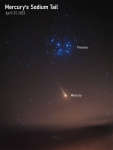 Mercurys Sodium Tail
3.05.2022
That's no comet. Below the Pleiades star cluster is actually a planet: Mercury. Long exposures of our Solar System's innermost planet may reveal something unexpected: a tail. Mercury's thin atmosphere contains small amounts of sodium that glow when excited by light from the Sun.
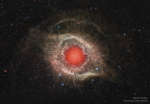 The Helix Nebula in Infrared
20.09.2016
What makes this cosmic eye look so red? Dust. The featured image from the robotic Spitzer Space Telescope shows infrared light from the well-studied Helix Nebula (NGC 7293) a mere 700 light-years away in the constellation of the Water Carrier Aquarius.
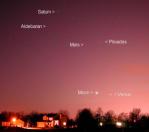 Planets in the West
18.04.2002
Have you seen any bright planets lately? Chances are if you've been outside under clear skies just after sunset, then you have. Now shining in the west as bright "stars" in the night sky, are all five planets of the solar system known to ancient astronomers - Mercury, Venus, Mars, Saturn, and Jupiter.
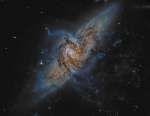 NGC 3314: When Galaxies Overlap
15.07.2011
NGC 3314 is actually two large spiral galaxies which just happen to almost exactly line up. The foreground spiral is viewed nearly face-on, its pinwheel shape defined by young bright star clusters. But against the glow of the background galaxy, dark swirling lanes of interstellar dust appear to dominate the face-on spiral's structure.
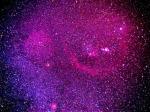 Orion: The Big Picture
1.12.1997
Orion is big. Some of the stars that form the constellation of Orion are part of a giant gas cloud complex that stretches over 100 light years and appears more than 50 times the diameter of the Moon.
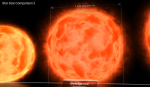 Star Size Comparison 2
12.06.2018
How big is our Sun compared to other stars? In dramatic and popular videos featured on YouTube, the relative sizes of planets, stars, and even the universe are shown from smallest to largest. The featured video begins with Earth's Moon and progresses through increasingly larger moons and planets in our Solar System.
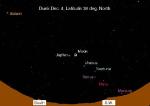 A Sky Full Of Planets
4.12.1997
Look up tonight. Just after sunset, the crescent moon and all five "naked-eye" planets (Mercury, Venus, Mars, Jupiter, and Saturn) will be visible (depending on your latitude), lying near our solar system's ecliptic plane.
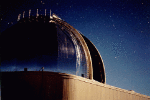 IRTF: Scanning the Infrared Skies
4.09.1996
Above, NASA's Infrared Telescope Facility (IRTF) poses in front of a starry background. Located on top of Hawaii's towering volcano Mauna Kea, the IRTF is the premier telescope for observing in near infrared light. This 3-meter telescope was established in 1979 and spends about half its time observing Solar System objects.
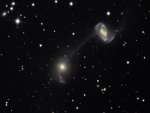 Galaxies on a String
31.07.2008
Galaxies NGC 5216 (top right) and NGC 5218 really do look like they are connected by a string. Of course, that string is a cosmic trail of gas, dust, and stars about 22,000 light-years long.
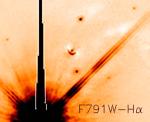 Diffraction Spikes: When Stars Look Like Crosses
19.11.1997
Unusual appendages around bright stars are commonplace, but never seem to be mentioned. What are they? First, a telescope brings starlight falling over a large area to a small area. To get at this...
|
January February March April May June July August September October |
|||||||||||||||||||||||||||||||||||||||||||||||||