
|
You entered: image
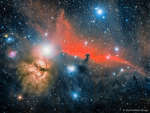 The Horsehead Nebula
16.12.2015
The Horsehead Nebula is one of the most famous nebulae on the sky. It is visible as the dark indentation to the red emission nebula in the center of the above photograph. The horse-head feature is dark because it is really an opaque dust cloud that lies in front of the bright red emission nebula.
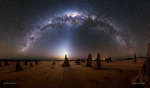 Milky Way over the Pinnacles in Australia
17.02.2016
What strange world is this? Earth. In the foreground of the featured image are the Pinnacles, unusual rock spires in Nambung National Park in Western Australia. Made of ancient sea shells (limestone), how these human-sized picturesque spires formed remains unknown.
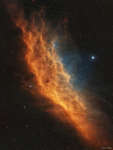 NGC 1499: The California Nebula
6.11.2018
There's even a California in space. Drifting through the Orion Arm of the spiral Milky Way Galaxy, this cosmic cloud by chance echoes the outline of California on the west coast of the United States.
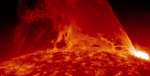 A Solar Prominence Eruption from SDO
26.05.2019
One of the most spectacular solar sights is an erupting prominence. In 2011, NASA's Sun-orbiting Solar Dynamic Observatory spacecraft imaged an impressively large prominence erupting from the surface. The dramatic explosion was captured in ultraviolet light in the featured time lapse video covering 90 minutes, where a new frame was taken every 24 seconds.
 IC 1805: The Heart Nebula
11.09.2019
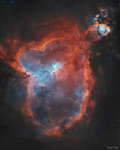
What energizes the Heart Nebula? First, the large emission nebula dubbed IC 1805 looks, in whole, like a human heart. The nebula glows brightly in red light emitted by its most prominent element: hydrogen. The red glow and the larger shape are all powered by a small group of stars near the nebula's center.
 The Annotated Galactic Center
27.09.2019
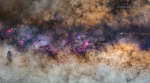
The center of our Milky Way galaxy can be found some 26,000 light-years away toward the constellation Sagittarius. Even on a dark night, you can't really see it though. Gaze in that direction, and your sight-line is quickly obscured by intervening interstellar dust.
 Threads of NGC 1947
7.04.2021
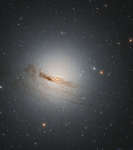
Found in far southern skies, deep within the boundaries of the constellation Dorado, NGC 1947 is some 40 million light-years away. In silhouette against starlight, obscuring lanes of cosmic dust thread across the peculiar galaxy's bright central regions.
 Orion Nebula: The Hubble View
29.06.2021
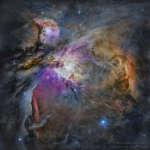
Few cosmic vistas excite the imagination like the Orion Nebula. Also known as M42, the nebula's glowing gas surrounds hot young stars at the edge of an immense interstellar molecular cloud only 1,500 light-years away.
 Remembering NEOWISE
31.07.2021
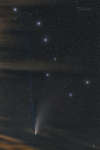
It was just last July. If you could see the stars of the Big Dipper, you could find Comet NEOWISE in your evening sky. After sunset denizens of the north could look for the naked-eye comet below the bowl of that famous celestial kitchen utensil and above the northwestern horizon.
 A 10 000 Kilometer Galactic Bridge
3.06.2022
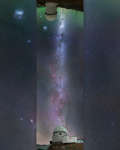
With this creative astro-collaboration you can follow the plane of our Milky Way Galaxy as it bridges northern and southern hemisphere skies. To construct the expansive composite nightscape, skies over Observatorio El Sauce...
|
January February March April May June July August September |
|||||||||||||||||||||||||||||||||||||||||||||||||