
|
You entered: Earth's moon
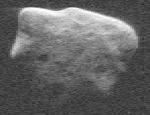 1999 JM8: A Rock Too Close
1.09.1999
Nearly four kilometers across, the huge rock known as 1999 JM8 silently passed only 8.5 million kilometers from the Earth in early August. The small asteroid was completely unknown before May. Every few centuries, a rock like this impacts the Earth, with the potential to disrupt modern civilization.
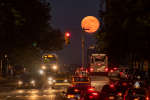 The East 96th Street Moon
30.06.2018
A very full Moon rose over Manhattan's Upper Eastside on June 28, known to some as the Strawberry Moon. Near the horizon, the warm yellow lunar disk was a bit ruffled and dimmed by a long sight-line through dense, hazy atmosphere.
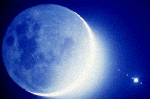 Tonight: A Blue Moon
30.07.1996
How often does a Full Moon occur twice in a single month? Exactly once in a Blue Moon. In fact, the modern usage of the term "Blue Moon" refers to the second Full Moon in a single month. Tonight's Blue Moon (Universal Time) will be the first since September 1993.
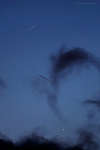 Clouds and Crescents
4.01.2014
A crescent Venus shines along the western horizon at dusk in this clearing sky. The Earth's sister planet is smiling between the low clouds near the bottom of the frame during its January 2nd conjunction with the slender, young crescent Moon above.
 Mercury: A Cratered Inferno
19.08.2001
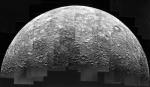
Mercury's surface looks similar to our Moon's. Each is heavily cratered and made of rock. Mercury's diameter is about 4800 km, while the Moon's is slightly less at about 3500 km (compared with about 12,700 km for the Earth). But Mercury is unique in many ways.
 Io: Moon Over Jupiter
8.04.2012
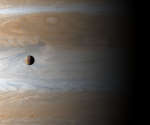
How big is Jupiter's moon Io? The most volcanic body in the Solar System, Io (usually pronounced "EYE-oh") is 3,600 kilometers in diameter, about the size of planet Earth's single large natural satellite.
 Lubovna Full Moon
15.07.2022
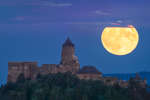
On July 13 this well-planned telephoto view recorded a Full Moon rising over Lubovna Castle in eastern Slovakia. The photographer was about 3 kilometers from the castle walls and about 357,000 kilometers from this Full Moon near perigee, the closest point in its elliptical orbit.
 Mercury: A Cratered Inferno
12.09.1996
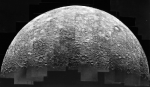
Mercury's surface looks similar to our Moon's. Each is heavily cratered and made of rock. Mercury's diameter is about 4800 km, while the Moon's is slightly less at about 3500 km (compared with about 12,700 km for the Earth). But Mercury is unique in many ways.
 Mercury: A Cratered Inferno
30.11.1997
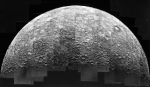
Mercury's surface looks similar to our Moon's. Each is heavily cratered and made of rock. Mercury's diameter is about 4800 km, while the Moon's is slightly less at about 3500 km (compared with about 12,700 km for the Earth). But Mercury is unique in many ways.
 Magnetar In The Sky
2.10.1998
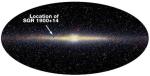
Indicated on this infrared image of the galactic center region is the position of SGR 1900+14 - the strongest known magnet in the galaxy. SGR 1900+14 is believed to be a city-sized, spinning, super-magnetic neutron star, or Magnetar. How strong is a Magnetar's magnetic field?
|
January February March April May June July August September |
|||||||||||||||||||||||||||||||||||||||||||||||||