
|
You entered: Ring Nebula
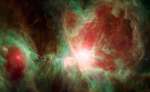 Spitzer s Orion
15.01.2014
Few cosmic vistas excite the imagination like the Orion Nebula, an immense stellar nursery some 1,500 light-years away. This stunning false-color view spans about 40 light-years across the region, constructed using infrared data from the Spitzer Space Telescope.
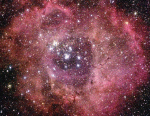 Star Cluster in the Rosette Nebula
22.05.1996
Embedded in the center of the colorful and photogenic Rosette Nebula is a bright, young open cluster. The bright blue stars in this cluster, labelled NGC 2244, emit ultraviolet light that knocks electrons away from hydrogen atoms.
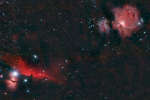 Horsehead and Orion Nebulae
10.03.2009
Adrift 1,500 light-years away in one of the night sky's most recognizable constellations, the glowing Orion Nebula and the dark Horsehead Nebula are contrasting cosmic vistas. They appear in opposite corners of this stunning mosaic taken with a digital camera attached to a small telescope.
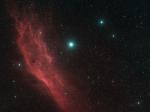 NGC 1499: The California Nebula
24.09.2006
What's California doing in space? Drifting through the Orion Arm of the spiral Milky Way Galaxy, this cosmic cloud by chance echoes the outline of California on the west coast of the United States.
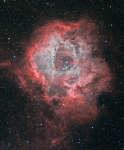 A Cosmic Rose: The Rosette Nebula in Monoceros
12.04.2019
The Rosette Nebula, NGC 2237, is not the only cosmic cloud of gas and dust to evoke the imagery of flowers, but it is the most famous. At the edge of a large molecular cloud in Monoceros some 5,000 light years away, the petals of this cosmic rose are actually a stellar nursery.
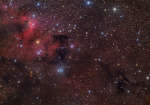 The Light, the Dark, and the Dusty
11.06.2015
This colorful skyscape spans about three full moons (1.5 degrees) across nebula rich starfields along the plane of our Milky Way Galaxy in the royal northern constellation Cepheus. Near the edge of the region...
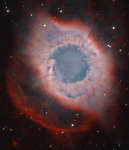 NGC 7293: The Helix Nebula
14.10.2021
A mere seven hundred light years from Earth, toward the constellation Aquarius, a sun-like star is dying. Its last few thousand years have produced the Helix Nebula (NGC 7293), a well studied and nearby example of a Planetary Nebula, typical of this final phase of stellar evolution.
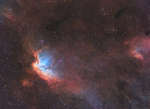 The Wizard Nebula
4.09.2020
Open star cluster NGC 7380 is still embedded in its natal cloud of interstellar gas and dust popularly known as the Wizard Nebula. Seen on the left, with foreground and background stars along the plane of our Milky Way galaxy it lies some 8,000 light-years distant, toward the constellation Cepheus.
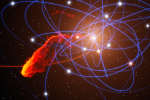 The Diner at the Center of the Galaxy
30.12.2011
The monster at the center of our Galaxy is about to get fed. Recent observations by the Very Large Telescopes indicate that a cloud of gas will venture too close to the supermassive black hole at the Galactic center.
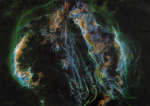 Supernova Remnant: The Veil Nebula
22.06.2022
Ten thousand years ago, before the dawn of recorded human history, a new light would have suddenly have appeared in the night sky and faded after a few weeks. Today we know this light was from a supernova, or exploding star, and record the expanding debris cloud as the Veil Nebula, a supernova remnant.
|
January February March April May June July August September October |
|||||||||||||||||||||||||||||||||||||||||||||||||