
|
You entered: Solar System
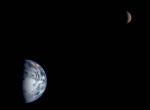 The Earth-Moon System
28.01.1998
This evocative mosaic image of the Earth-Moon system was recorded by NASA's Near Earth Asteroid Rendezvous (NEAR) spacecraft earlier this month. The relative sizes shown are appropriate for viewing both the Earth...
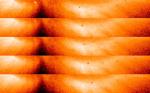 X-ray Transit of Mercury
2.07.1998
This sequence of false color X-ray images captures a rare event - the passage or transit of planet Mercury in front of the Sun. Mercury's small disk is silhouetted against the bright background of X-rays from the hot Solar Corona.
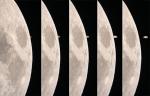 Saturn at the Lunar Limb
21.02.2002
Gliding through the sky on Wednesday evening, February 20th, a first quarter Moon seemed to run over bright planet Saturn as viewed from much of North America. In this sharp sequence of telescopic digital...
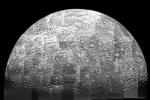 Outbound from Mercury
16.07.2002
After just passing Mercury, the robot spacecraft Mariner 10 looked back. The above picture is what it saw. Mercury, the closest planet to the Sun, is heavily cratered much like Earth's Moon.
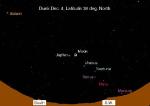 A Sky Full Of Planets
3.12.1997
Look up tonight. Just after sunset, the crescent moon and all five "naked-eye" planets (Mercury, Venus, Mars, Jupiter, and Saturn) will be visible (depending on your latitude), lying near our solar system's ecliptic plane.
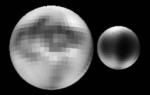 Mysterious Pluto and Charon
8.07.1998
Pluto is the only planet in our Solar System remaining unphotographed by a passing spacecraft. Distant Pluto and its moon Charon therefore remain somewhat mysterious. In addition to direct imaging by the Hubble Space...
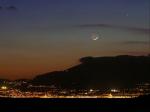 Moon, Mercury, Monaco
17.03.2005
Low on the western horizon after sunset, a slender crescent Moon and wandering planet Mercury join the lights of Menton and Monaco along the French Riviera. Astronomer Vincent Jacques took advantage of this gorgeous...
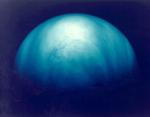 Venus: Just Passing By
25.06.2005
Venus, the second closest planet to the Sun, is by far the brightest of the three planets gathered in this weekend's western sky at sunset. It has also proven to be a popular way-point for spacecraft headed for the gas giant planets in the outer reaches of the solar system. Why visit Venus first?
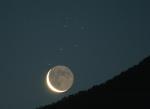 Old Moon and Sister Stars
29.06.2006
An old crescent Moon shares the eastern sky over Menton, France with the sister stars of the Pleiades cluster in this early morning skyscape recorded just last Friday, June 23rd. (Bright Venus was also...
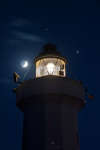 Great Conjunction over Sicilian Lighthouse
7.12.2020
DonБt miss the coming great conjunction. In just under two weeks, the two largest planets in our Solar System will angularly pass so close together in Earth's sky that the Moon would easily be able to cover them both simultaneously. This pending planetary passage -- on December 21 -- will be the closest since 1623.
|
January February March April May June July August |
||||||||||||||||||||||||||||||||||||||||||||||||||||||||