
|
You entered: comet
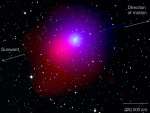 The Swift View of Comet Lulin
21.02.2009
Now growing brighter, Comet Lulin is headed for its closest approach to planet Earth early next week. But the comet's greenish glow, familiar to earthbound skygazers, is replaced by false colors in this premier view from the orbiting Swift satellite.
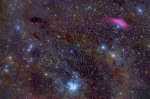 Comet PanSTARRS is near the Edge
16.02.2018
The comet PanSTARRS, also known as the blue comet (C/2016 R2), really is near the lower left edge of this stunning, wide field view recorded on January 13. Spanning nearly 20 degrees on the sky, the cosmic landscape is explored by well-exposed and processed frames from a sensitive digital camera.
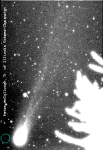 Comet Hyakutake Passes the Earth
25.03.1996
This picture of Comet Hyakutake taken the night of March 21/22 in Illinois, USA shows the enormous tail that has already developed. The silhouette on the right is a foreground tree, and the superposed green circle on the left shows the size of the full moon.
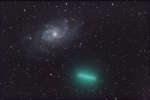 APOD: 2008 January 2- A Galaxy is not a Comet
2.01.2008
This gorgeous galaxy and comet portrait was recorded on December 30th, in the skies over Hoogeveen, The Netherlands. The combined series of 60 x 60 second exposures finds the lovely green coma of Comet 8P/Tuttle near its predicted conjunction with the Triangulum Galaxy.
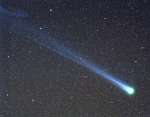 Comet Hyakutake Passes the Earth
16.12.2009
In 1996, an unexpectedly bright comet passed by planet Earth. Discovered less than two months before, Comet C/1996 B2 Hyakutake came within only 1/10th of the Earth-Sun distance from the Earth in late March.
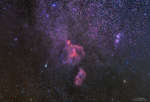 Comet Heart and Soul
23.08.2018
The greenish coma of comet 21P/Giacobini-Zinner stands out at the left of this telephoto skyscape spanning over 10 degrees toward the northern constellations Cassiopeia and Perseus. Captured on August 17, the periodic comet is the known parent body of the upcoming Draconid meteor shower.
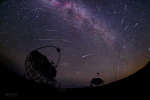 Gamma rays and Comet Dust
20.08.2016
Gamma-rays and dust from periodic Comet Swift-Tuttle plowed through planet Earth's atmosphere on the night of August 11/12. Impacting at about 60 kilometers per second the grains of comet dust produced this year's remarkably active Perseid meteor shower.
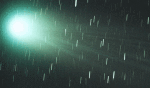 Comet Hyakutake's Closest Approach
24.03.1996
The above true color image of Comet Hyakutake was taken the night of March 21/22. Tonight, Comet Hyakutake will make its nearest approach to Earth, closing to a mere 10 million miles as it passes over the planet's Northern Hemisphere.
 Periodic Comet Swift-Tuttle
19.02.1996
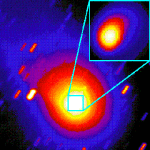
Comet Swift-Tuttle, shown above in false color, is the largest object known to make repeated passes near the Earth. It is also one of the oldest known periodic comets with sightings spanning two millennia.
 APOD: 2020 July 22 Б The Structured Tails of Comet NEOWISE
22.07.2020
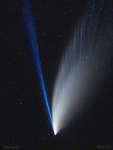
What is creating the structure in Comet NEOWISE's tails? Of the two tails evident, the blue ion tail on the left points directly away from the Sun and is pushed out by the flowing and charged solar wind.
|
January February March April May June July August September October |
|||||||||||||||||||||||||||||||||||||||||||||||||