
|
You entered: composite image
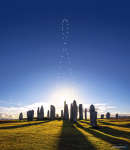 Analemma over the Callanish Stones
18.09.2022
If you went outside at the same time every day and took a picture that included the Sun, how would the Sun's position change? A more visual answer to that question is an analemma, a composite image taken from the same spot at the same time over the course of a year.
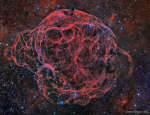 Simeis 147: Supernova Remnant
18.05.2017
It's easy to get lost following intricate filaments in this detailed image of faint supernova remnant Simeis 147. Also cataloged as Sharpless 2-240 it goes by the popular nickname, the Spaghetti Nebula. Seen toward the boundary of the constellations Taurus and Auriga, it covers nearly 3 degrees or 6 full moons on the sky.
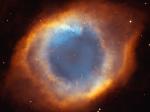 NGC 7293: The Helix Nebula
10.05.2003
Will our Sun look like this one day? The Helix Nebula is the closest example of a planetary nebula created at the end of the life of a Sun-like star. The outer gasses of the star expelled into space appear from our vantage point as if we are looking down a helix.
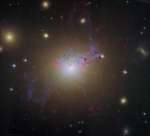 Hubble Remix: Active Galaxy NGC 1275
6.10.2013
Active galaxy NGC 1275 is the central, dominant member of the large and relatively nearby Perseus Cluster of Galaxies. Wild-looking at visible wavelengths, the active galaxy is also a prodigious source of x-rays and radio emission.
 Stripping ESO 137-001
1.08.2015
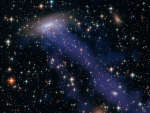
Spiral galaxy ESO 137-001 hurtles through massive galaxy cluster Abell 3627 some 220 million light years away. The distant galaxy is seen in this colorful Hubble/Chandra composite image through a foreground of the Milky Way's stars toward the southern constellation Triangulum Australe.
 Stripping ESO 137-001
25.08.2018
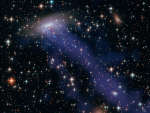
Spiral galaxy ESO 137-001 hurtles through massive galaxy cluster Abell 3627 some 220 million light years away. The distant galaxy is seen in this colorful Hubble/Chandra composite image through a foreground of the Milky Way's stars toward the southern constellation Triangulum Australe.
 Equinox: The Sun from Solstice to Solstice
22.09.2008
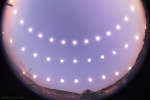
Today is an equinox, a date when day and night are equal. Tomorrow, and every day until the next equinox, the night will be longer than the day in Earth's northern hemisphere, and the day will be longer than the night in Earth's southern hemisphere.
 Equinox: The Sun from Solstice to Solstice
23.09.2012
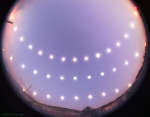
Yesterday was an equinox, a date when day and night are equal. Today, and every day until the next equinox, the night will be longer than the day in Earth's northern hemisphere, and the day will be longer than the night in Earth's southern hemisphere.
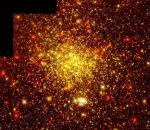 NGC1850: Star Cluster in the LMC
20.06.1997
NGC1850 is a large cluster of stars located a mere 166,000 light-years from Earth in our neighboring galaxy the Large Magellanic Cloud (LMC). The colors in this beautiful Hubble Space Telescope composite image of the cluster reveal different populations of stars.
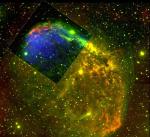 NGC 6888: X Rays in the Wind
16.10.2003
NGC 6888, also known as the Crescent Nebula, is a cosmic bubble of interstellar gas about 25 light-years across. Created by winds from the bright, massive star seen near the center of this composite image, the shocked filaments of gas glowing at optical wavelengths are represented in green and yellowish hues.
|
January February March April May June July August |
||||||||||||||||||||||||||||||||||||||||||||||||||||||||