
|
You entered: emission nebula
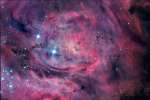 M8: The Lagoon Nebula
5.08.2010
This beautiful cosmic cloud is a popular stop on telescopic tours of the constellation Sagittarius. Eighteenth century cosmic tourist Charles Messier cataloged the bright nebula as M8. Modern day astronomers recognize the Lagoon Nebula as an active stellar nursery about 5,000 light-years distant, in the direction of the center of our Milky Way Galaxy.
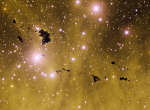 Thackerays Globules
12.06.2012
These are larger dust bunnies than you will find under your bed. Situated in rich star fields and glowing hydrogen gas, these opaque clouds of interstellar dust and gas are so large they might be able to form stars.
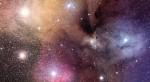 The Colorful Clouds of Rho Ophiuchi
9.07.2005
The many spectacular colors of the Rho Ophiuchi (oh'-fee-yu-kee) clouds highlight the many processes that occur there. The blue regions shine primarily by reflected light. Blue light from the star Rho Ophiuchi and nearby stars reflects more efficiently off this portion of the nebula than red light.
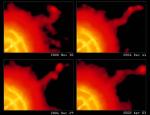 The Vela Pulsar s Dynamic Jet
3.07.2003
The Vela pulsar is a neutron star born over 10,000 years ago in a massive supernova explosion. Above, false-color x-ray images from the Chandra Observatory reveal details of this remnant pulsar's x-ray bright nebula along with emission from a spectacular jet of high-energy particles.
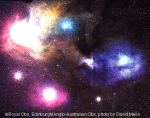 The Colorful Clouds of Rho Ophiuchi
12.03.1996
The many spectacular colors of the Rho Ophiuchi (oh'-fee-yu-kee) clouds highlight the many processes that occur there. The blue regions shine primarily by reflected light. Blue light from the star rho Ophiuchi and nearby stars reflects more efficiently off this portion of the nebula than red light.
 Elephant s Trunk and Caravan
8.06.2023
Like an illustration in a galactic Just So Story, the Elephant's Trunk Nebula winds through the emission region and young star cluster complex IC 1396, in the high and far off constellation of Cepheus. Seen on the left the cosmic elephant's trunk, also known as vdB 142, is over 20 light-years long.
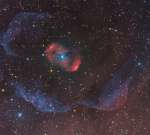 A Halo for NGC 6164
22.05.2014
Beautiful emission nebula NGC 6164 was created by a rare, hot, luminous O-type star, some 40 times as massive as the Sun. Seen at the center of the cosmic cloud, the star is a mere 3 to 4 million years old.
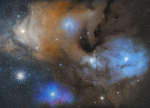 The Colorful Clouds of Rho Ophiuchi
3.12.2013
The many spectacular colors of the Rho Ophiuchi (oh'-fee-yu-kee) clouds highlight the many processes that occur there. The blue regions shine primarily by reflected light. Blue light from the star Rho Ophiuchi and nearby stars reflects more efficiently off this portion of the nebula than red light.
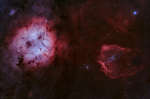 Elephant, Bat, and Squid
23.07.2021
Sprawling emission nebulae IC 1396 and Sh2-129 mix glowing interstellar gas and dark dust clouds in this 10 degree wide field of view toward the northern constellation Cepheus the King. Energized by its bluish central star IC 1396 (left) is hundreds of light-years across and some 3,000 light-years distant.
 APOD: 2025 July 16 Б The Rosette Nebula from DECam
16.07.2025
Would the Rosette Nebula by any other name look as sweet? The bland New General Catalog designation of NGC 2237 doesn't appear to diminish the appearance of this flowery emission nebula, as captured by the Dark Energy Camera (DECam) on the Blanco 4-meter telescope at the NSF's Cerro Tololo Inter-American Observatory in Chile.
|
January February March April May June July August September October |
|||||||||||||||||||||||||||||||||||||||||||||||||