
|
You entered: full moon
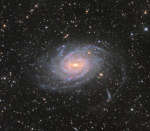 Spiral Galaxy NGC 6744
5.12.2019
Beautiful spiral galaxy NGC 6744 is nearly 175,000 light-years across, larger than our own Milky Way. It lies some 30 million light-years distant in the southern constellation Pavo and appears as only a faint, extended object in small telescopes.
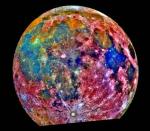 The Colorful Moon
16.03.2002
Do you recognize the Earth's Moon when you see it? The crazy, patchwork appearance of the false-color image makes this almost full view of the Moon's familiar near side look very strange.
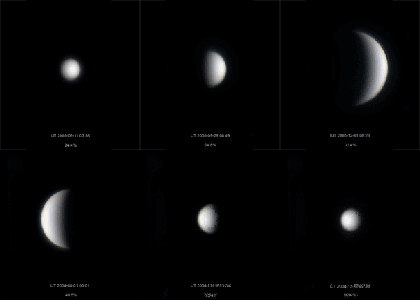 The Phases of Venus
10.01.2006
Venus goes through phases. Just like our Moon, Venus can appear as full as a disk or as a thin as a crescent. Venus, frequently the brightest object in the post-sunset or pre-sunrise sky, appears so small, however, that it usually requires binoculars or a small telescope to clearly see its current phase.
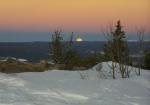 Shadow Set
27.01.2005
A nearly full Moon and planet Earth's shadow set together in this scene captured Monday from snowy Mt. Jelm, home of the Wyoming Infrared Observatory. For early morning risers (and late...
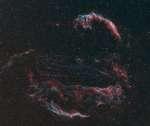 The Veil Nebula
16.09.2010
Delicate in appearance, these filaments of shocked, glowing gas, draped in planet Earth's sky toward the constellation of Cygnus, make up the Veil Nebula. The nebula is a large supernova remnant, an expanding cloud born of the death explosion of a massive star.
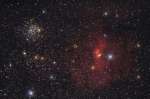 The Bubble and M52
14.09.2011
To the eye, this cosmic composition nicely balances the Bubble Nebula at the lower right with open star cluster M52. The pair would be lopsided on other scales, though. Embedded in a complex...
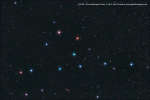 Collinder 399: The Coat Hanger
26.08.2015
Is this coat hanger a star cluster or an asterism? This cosmic hang-up has been debated over much of last century, as astronomers wondered whether this binocular-visible object is really a physically associated open cluster or a chance projection. Chance star projections are known as asterisms, an example of which is the popular Big Dipper.
 APOD: 2025 August 3 Б Milky Way and Exploding Meteor
3.08.2025
In about a week the Perseid Meteor Shower will reach its maximum. Grains of icy rock will streak across the sky as they evaporate during entry into Earth's atmosphere. These grains were shed from Comet Swift-Tuttle.
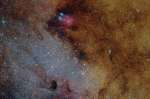 Messier 24: Sagittarius Star Cloud
29.06.2018
Unlike most entries in Charles Messier's famous catalog of deep sky objects, M24 is not a bright galaxy, star cluster, or nebula. It's a gap in nearby, obscuring intertellar dust clouds that allows a view of the distant stars in the Sagittarius spiral arm of our Milky Way galaxy.
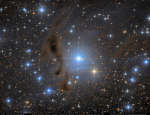 Reflections on vdB 9
21.02.2019
Centered in a well-composed celestial still life, pretty, blue vdB 9 is the 9th object in Sidney van den Bergh's 1966 catalog of reflection nebulae. It shares this telescopic field of view, about...
|
January February March April May June July August September October |
|||||||||||||||||||||||||||||||||||||||||||||||||