
|
You entered: galaxy center
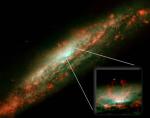 The Bubbling Cauldron of NGC 3079
22.08.2001
Edge-on spiral galaxy NGC 3079 is a mere 50 million light-years away toward the constellation Ursa Major. Shown in this stunning false-color Hubble Space Telescope image, the galaxy's disk - composed of spectacular star clusters in winding spiral arms and dramatic dark lanes of dust - spans some 70,000 light-years.
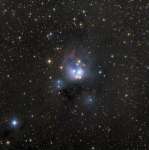 Young Suns of NGC 7129
4.09.2010
Young suns still lie within dusty NGC 7129, some 3,000 light-years away toward the royal constellation Cepheus. While these stars are at a relatively tender age, only a few million years old, it is likely that our own Sun formed in a similar stellar nursery some five billion years ago.
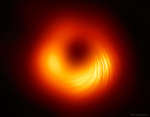 M87s Central Black Hole in Polarized Light
30.03.2021
To play on Carl SaganБs famous words "If you wish to make black hole jets, you must first create magnetic fields." The featured image represents the detected intrinsic spin direction (polarization) of radio waves. The polarizationi is produced by the powerful magnetic field surrounding the supermassive black hole at the center of elliptical galaxy M87.
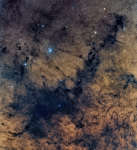 The Pipe Nebula
6.08.2020
East of Antares, dark markings sprawl through crowded star fields toward the center of our Milky Way Galaxy. Cataloged in the early 20th century by astronomer E. E. Barnard, the obscuring interstellar dust clouds include B59, B72, B77 and B78, seen in against the starry background.
 M33: Triangulum Galaxy
20.12.2012
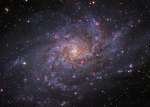
The small, northern constellation Triangulum harbors this magnificent face-on spiral galaxy, M33. Its popular names include the Pinwheel Galaxy or just the Triangulum Galaxy. M33 is over 50,000 light-years in diameter, third largest in the Local Group of galaxies after the Andromeda Galaxy (M31), and our own Milky Way.
 The Southern Sky in Warm Hydrogen
28.01.2002
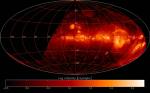
A robotic telescope with red sunglasses in Chile has been photographing the entire southern sky for years. The result, shown above, is the most complete sky map of the most common visible light emitted from the most abundant element in our Galaxy: hydrogen. A very specific red color emitted by warm ionized hydrogen was observed.
 Too Close to a Black Hole
4.01.1997
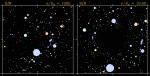
What would you see if you went right up to a black hole? Above are two computer generated pictures highlighting how strange things would look. On the left is a normal star field containing the constellation Orion. Notice the three stars of nearly equal brightness that make up Orion's Belt.
 The Bubbling Cauldron of NGC 3079
16.10.2004
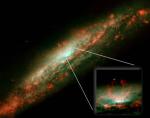
Edge-on spiral galaxy NGC 3079 is a mere 50 million light-years away toward the constellation Ursa Major. Shown in this stunning false-color Hubble Space Telescope image, the galaxy's disk - composed of spectacular star clusters in winding spiral arms and dramatic dark lanes of dust - spans some 70,000 light-years.
 NGC 253: Dusty Island Universe
21.03.2018
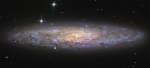
Shiny NGC 253 is one of the brightest spiral galaxies visible, and also one of the dustiest. Some call it the Silver Dollar Galaxy for its appearance in small telescopes, or just the Sculptor Galaxy for its location within the boundaries of the southern constellation Sculptor.
 The Compton Observatory Turns Five
13.04.1996
Earlier this April, NASA's Compton Gamma Ray Observatory, completed its fifth successful year in orbit, exploring the gamma ray sky. Pictured is astronaut Jay Apt perched in the shuttle payload bay below the massive observatory. Compton is the largest civilian instrument ever flown - the whole observatory is roughly the size of a school bus.
|
January February March April May June July August |
||||||||||||||||||||||||||||||||||||||||||||||||||||||||