
|
You entered: interstellar dust
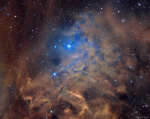 AE Aurigae and the Flaming Star Nebula
25.02.2018
Why is AE Aurigae called the flaming star? For one reason, the surrounding nebula IC 405 is named the Flaming Star Nebula because the region seems to harbor smoke, even though nothing is on fire, including interior star AE Aurigae.
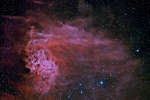 AE Aurigae and the Flaming Star Nebula
26.01.2009
Is star AE Aurigae on fire? No. Even though AE Aurigae is named the flaming star, the surrounding nebula IC 405 is named the Flaming Star Nebula, and the region appears to harbor red smoke, there is no fire.
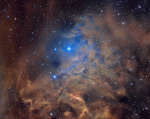 AE Aurigae and the Flaming Star Nebula
7.01.2013
AE Aurigae is called the flaming star. The surrounding nebula IC 405 is named the Flaming Star Nebula and the region seems to harbor smoke, but there is no fire. Fire, typically defined...
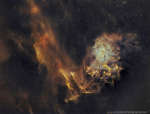 AE Aurigae and the Flaming Star Nebula
10.11.2015
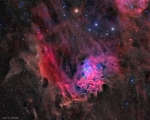
Is star AE Aurigae on fire? No. Even though AE Aurigae is named the flaming star, the surrounding nebula IC 405 is named the Flaming Star Nebula, and the region appears to have the color of fire, there is no fire.
 AE Aurigae and the Flaming Star Nebula
26.03.2019
Is star AE Aurigae on fire? No. Even though AE Aurigae is named the flaming star, the surrounding nebula IC 405 is named the Flaming Star Nebula, and the region shape gives the appearance of fire, there is no fire.
 Cosmic Rays and Supernova Dust
18.06.1998
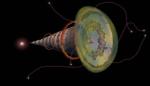
Cosmic Rays are celestial high energy particles traveling at nearly the speed of light, which constantly bombard the Earth. Discovered during high altitude balloon flights in 1912 their source has been a long standing mystery.
 Dark Cloud
26.02.1999
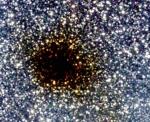
Ominously foreshadowing events to come, a dark cloud of obscuring dust stands out against a luminous star field in the Milky Way. Cataloged as Feitzinger and Stuwe object "1-457" this fuliginous interstellar nebula is relatively close - possibly only 1,000 light-years distant.
 The Tadpoles of IC 410
13.11.2015
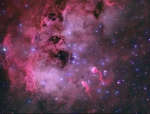
This telescopic close-up shows off the otherwise faint emission nebula IC 410. It also features two remarkable inhabitants of the cosmic pond of gas and dust below and right of center, the tadpoles of IC 410. Partly obscured by foreground dust, the nebula itself surrounds NGC 1893, a young galactic cluster of stars.
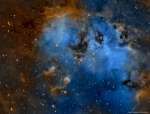 The Tadpoles of IC 410
24.01.2018
This telescopic close-up shows off the otherwise faint emission nebula IC 410. It also features two remarkable inhabitants of the cosmic pond of gas and dust below and left of center, the tadpoles of IC 410. Partly obscured by foreground dust, the nebula itself surrounds NGC 1893, a young galactic cluster of stars.
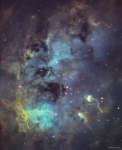 The Tadpoles of IC 410
18.06.2020
This telescopic close-up shows off the central regions of otherwise faint emission nebula IC 410, captured under backyard suburban skies with narrowband filters. It also features two remarkable inhabitants of the cosmic pond of gas and dust. Below and right of center are the tadpoles of IC 410.
|
January February March April May June July August September |
|||||||||||||||||||||||||||||||||||||||||||||||||