
|
You entered: red giant
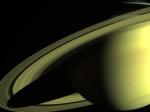 24 Million Kilometers to Saturn
31.05.2004
Next stop: Saturn. The Cassini-Huygens spacecraft is approaching Saturn and will fire its engines to break into orbit around the ringed giant on July 1. The robot spacecraft was launched in 1997 and rounded Jupiter in 2001.
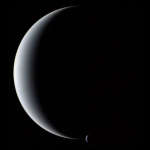 Crescent Neptune and Triton
13.12.2009
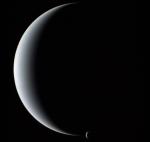
Gliding silently through the outer Solar System, the Voyager 2 spacecraft camera captured Neptune and Triton together in crescent phase in 1989. The above picture of the gas giant planet and its cloudy moon was taken from behind just after closest approach.
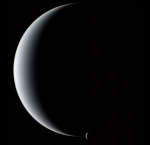 Crescent Neptune and Triton
14.04.2013
Gliding silently through the outer Solar System, the Voyager 2 spacecraft camera captured Neptune and Triton together in crescent phase in 1989. The elegant picture of the gas giant planet and its cloudy moon was taken from behind just after closest approach.
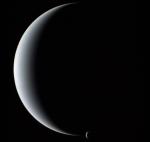 Crescent Neptune and Triton
19.06.2001
Gliding silently through the outer Solar System, the Voyager 2 spacecraft camera captured Neptune and Triton together in crescent phase in 1989. The above picture of the gas giant planet and its cloudy moon was taken from behind just after closest approach.
 Crescent Neptune and Triton
18.06.2006
Gliding silently through the outer Solar System, the Voyager 2 spacecraft camera captured Neptune and Triton together in crescent phase in 1989. The above picture of the gas giant planet and its cloudy moon was taken from behind just after closest approach.
 APOD: 2025 July 18 Б ISS Meets Saturn
18.07.2025
This month, bright planet Saturn rises in evening skies, its rings oriented nearly edge-on when viewed from planet Earth. And in the early morning hours on July 6, it posed very briefly with the International Space Station when viewed from a location in Federal Way, Washington, USA.
 Neptune: Big Blue Giant
21.02.1998
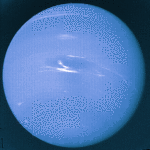
This picture was taken by the Voyager 2 spacecraft in 1989 - the only spacecraft ever to visit Neptune. Neptune will be the farthest planet from the Sun until 1999, when the elliptical orbit of Pluto will cause it to once again resume this status.
 M86 in the Central Virgo Cluster
14.08.2018
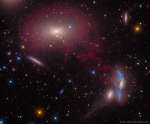
Is there a bridge of gas connecting these two great galaxies? Quite possibly, but it is hard to be sure. M86 on the upper left is a giant elliptical galaxy near the center of the nearby Virgo Cluster of galaxies.
 The W in Cassiopeia
18.03.2016
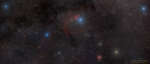
A familiar, zigzag, W pattern in northern constellation Cassiopeia is traced by five bright stars in this colorful and broad mosaic. Stretching about 15 degrees across rich starfields, the celestial scene includes dark clouds, bright nebulae, and star clusters along the Milky Way. In yellow-orange hues Cassiopeia's alpha star Shedar is a standout though.
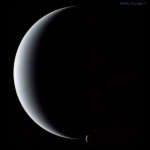 Crescent Neptune and Triton
25.07.2021
Gliding silently through the outer Solar System, the Voyager 2 spacecraft camera captured Neptune and Triton together in crescent phase. The elegant picture of the gas giant planet and its cloudy moon was taken from behind just after closest approach in 1989.
|
January February March April May June July August September October |
|||||||||||||||||||||||||||||||||||||||||||||||||