
|
You entered: ring galaxy
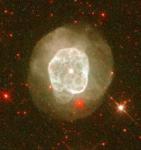 Nebulae For Christmas
25.12.1998
If our Galaxy were a Christmas tree, planetary nebulae would adorn it like colorful lighted ornaments twinkling on a cosmic scale. Glowing shrouds of gas ejected by red giant stars, planetary nebulae like...
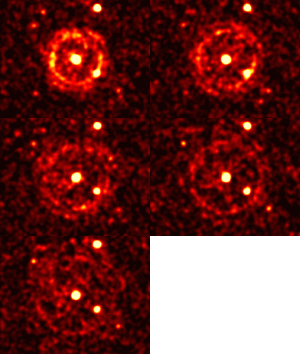 X Ray Rings Expand from a Gamma Ray Burst
30.01.2004
Why do x-ray rings appear to emanate from a gamma-ray burst? The surprising answer has little to do with the explosion itself but rather with light reflected off sheets of dust-laden gas in our own Milky Way Galaxy.
 APOD: 2025 May 27 Б Zeta and Rho Ophiuchi with Milky Way
27.05.2025
Behold one of the most photogenic regions of the night sky, captured impressively. Featured, the band of our Milky Way Galaxy runs diagonally along the bottom-left corner, while the colorful Rho Ophiuchi cloud complex is visible just right of center and the large red circular Zeta Ophiuchi Nebula appears near the top.
 APOD: 2023 May 29 Б Milky Way over a Turquoise Wonderland
29.05.2023
What glows there? The answer depends: sea or sky? In the sea, the unusual blue glow is bioluminescence. Specifically, the glimmer arises from Noctiluca scintillans, single-celled plankton stimulated by the lapping waves. The plankton use their glow to startle and illuminate predators.
 Crossing Horizons
25.11.2017
Follow this vertical panoramic view from horizon to horizon and your gaze will sweep through the zenith of a dark night sky over Pic du Midi mountaintop observatory. To make the journey above...
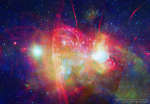 The Galactic Center from Radio to X ray
31.03.2020
In how many ways does the center of our Galaxy glow? This enigmatic region, about 26,000 light years away toward the constellation of the Archer (Sagittarius), glows in every type of light that we can see.
 Around The Arches Cluster
14.06.2001
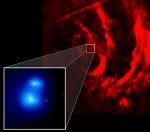
The most compact cluster of stars known in our galaxy, the Arches cluster, boasts 100 or so massive, young stars contained within a diameter of one light-year. Seen toward the constellation Sagittarius, the Arches...
 M51: The Whirlpool Galaxy in Dust and Stars
10.04.2001
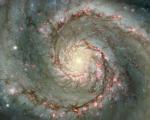
The Whirlpool Galaxy is a classic spiral galaxy. At only 30 million light years distant and fully 60 thousand light years across, M51, also known as NGC 5194, is one of the brightest and most picturesque galaxies on the sky.
 M51: The Whirlpool Galaxy in Dust and Stars
5.09.2004
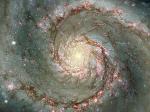
The Whirlpool Galaxy is a classic spiral galaxy. At only 30 million light years distant and fully 60 thousand light years across, M51, also known as NGC 5194, is one of the brightest and most picturesque galaxies on the sky.
 M51: The Whirlpool Galaxy in Dust and Stars
19.02.2006
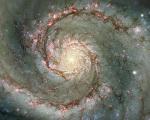
The Whirlpool Galaxy is a classic spiral galaxy. At only 30 million light years distant and fully 60 thousand light years across, M51, also known as NGC 5194, is one of the brightest and most picturesque galaxies on the sky.
|
January February March April May June July August September October |
|||||||||||||||||||||||||||||||||||||||||||||||||