
|
You entered: satellite
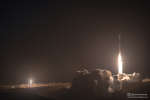 West Coast Launch and Landing
10.10.2018
A SpaceX Falcon 9 rocket launch dazzled viewers along the U.S. west coast after sunset on October 7. Rising from Vandenberg Air Force Base, California, planet Earth, the Falcon 9's first stage then returned to a landing zone some 400 meters from the launch site less than 8 minutes after liftoff.
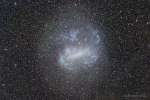 APOD: 2023 March 7 Б Deep Field: The Large Magellanic Cloud
6.03.2023
Is this a spiral galaxy? No. Actually, it is the Large Magellanic Cloud (LMC), the largest satellite galaxy of our own Milky Way Galaxy. The LMC is classified as a dwarf irregular galaxy because of its normally chaotic appearance. In this deep and wide exposure, however, the full extent of the LMC becomes visible.
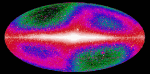 Stars in the Infrared Sky
18.09.1996
What if you could see infrared light? Because this light is less absorbed by dust than visible light, you could peer into the center of our Milky Way Galaxy. The stars there are normally hidden from direct view by the interstellar dust clouds which line the Galactic plane.
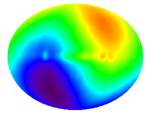 CMBR Dipole: Speeding Through the Universe
8.03.2008
Our Earth is not at rest. The Earth moves around the Sun. The Sun orbits the center of the Milky Way Galaxy. The Milky Way Galaxy orbits in the Local Group of Galaxies. The Local Group falls toward the Virgo Cluster of Galaxies.
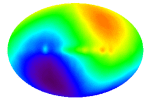 CMBR Dipole: Speeding Through the Universe
6.09.2009
Our Earth is not at rest. The Earth moves around the Sun. The Sun orbits the center of the Milky Way Galaxy. The Milky Way Galaxy orbits in the Local Group of Galaxies. The Local Group falls toward the Virgo Cluster of Galaxies.
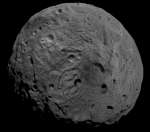 The South Pole of Asteroid Vesta
19.09.2011
What created the circular structure around the south pole of asteroid Vesta? Pictured above, the bottom of the second largest object in the asteroid belt was recently imaged for the first time by the robotic Dawn satellite that arrived last month.
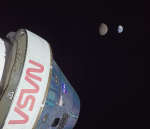 Artemis I: Flight Day 13
30.01.2026
On flight day 13 (November 28, 2022) of the Artemis 1 mission, the Orion spacecraft reached its maximum distance from Earth. At over 430,000 kilometers from Earth, its distant retrograde orbit also puts Orion nearly 70,000 kilometers from the Moon.
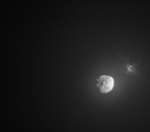 DART Asteroid Impact from Space
28.09.2022
Fifteen days before impact, the DART spacecraft deployed a small companion satellite to document its historic planetary defense technology demonstration. Provided by the Italian Space Agency, the Light Italian CubeSat for Imaging Asteroids, aka LICIACube, recorded this image of the event's aftermath.
 Eclipsed Moon in Infrared
15.09.2001
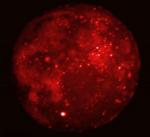
The total lunar eclipse of September 1996 disappointed many observers in North America who were cursed with cloudy skies. However, the Midcourse Space Experiment (MSX) satellite had a spectacular view from Earth orbit and SPIRIT III, an onboard infrared telescope, was used to repeatedly image the moon during the eclipse.
 Spinning Black Holes and MCG 6 30 15
28.10.2001
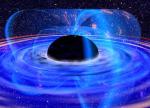
What makes the core of galaxy MCG-6-30-15 so bright? Some astronomers believe the answer is a massive spinning black hole. If so, this would be the first observational indication that it is possible to make a black hole act like a battery -- and tap into its rotational energy.
|
January February March April May June July August |
||||||||||||||||||||||||||||||||||||||||||||||||||||||||