
|
You entered: spiral arms
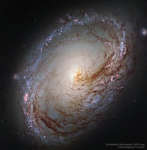 Spiral Galaxy M96 from Hubble
21.09.2015
Dust lanes seem to swirl around the core of Messier 96 in this colorful, detailed portrait of the center of a beautiful island universe. Of course M96 is a spiral galaxy, and counting...
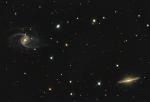 APOD: 2006 September 29- NGC 5905 and 5908
29.09.2006
These two beautiful galaxies, NGC 5905 (left) and NGC 5908 lie about 140 million light-years distant in the northern constellation Draco. Separated by about 500,000 light-years, the pair are actually both spiral galaxies and nicely illustrate the striking contrasts in appearance possible when viewing spirals from different perspectives.
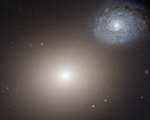 Elliptical M60, Spiral NGC 4647
28.01.2016
Giant elliptical galaxy M60 and spiral galaxy NGC 4647 do look like an odd couple in this sharp cosmic portrait from the Hubble Space Telescope. But they are found in a region of space where galaxies tend to gather, on the eastern side of the nearby Virgo Galaxy Cluster.
 Elliptical M60, Spiral NGC 4647
14.09.2012
Giant elliptical galaxy M60 and spiral galaxy NGC 4647 do look like an odd couple in this sharp cosmic portrait from the Hubble Space Telescope. But they are found in a region of space where galaxies tend to gather, on the eastern side of the nearby Virgo Galaxy Cluster.
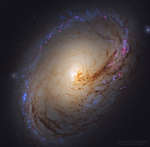 Spiral Galaxy M96 from Hubble
12.06.2019
Dust lanes seem to swirl around the core of Messier 96 in this colorful, detailed portrait of the center of a beautiful island universe. Of course M96 is a spiral galaxy, and counting...
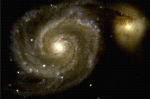 M51: The Whirlpool Galaxy
25.01.1997
The Whirlpool Galaxy is a classic spiral galaxy. At only 15 million light years distant, M51, also cataloged as NGC 5194, is one of the brighter and more picturesque galaxies on the sky.
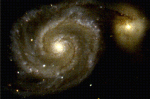 M51: The Whirlpool Galaxy
18.12.1995
The Whirlpool Galaxy is frequently given as an example of a galaxy with classic spiral design. At only 15 million light years distant, M51, also cataloged as NGC 5194, is also one of the brighter and more picturesque galaxies on the sky.
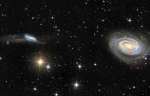 Arp 159 and NGC 4725
3.09.2015
Pointy stars and peculiar galaxies span this cosmic snapshot, a telescopic view toward the well-groomed constellation Coma Berenices. Bright enough to show off diffraction spikes, the stars are in the foreground of the scene, well within our own Milky Way. But the two prominent galaxies lie far beyond our own, some 41 million light-years distant.
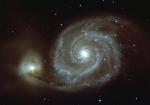 M51: The Whirlpool Galaxy
24.07.2000
The Whirlpool Galaxy is a classic spiral galaxy. At only 23 million light years distant and fully 65 thousand light years across, M51, also known as NGC 5194, is one of the brightest and most picturesque galaxies on the sky.
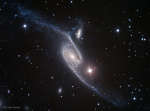 NGC 6872: A Stretched Spiral Galaxy
26.04.2016
What makes this spiral galaxy so long? Measuring over 700,000 light years across from top to bottom, NGC 6872, also known as the Condor galaxy, is one of the most elongated barred spiral galaxies known.
|
January February March April May June July August September |
|||||||||||||||||||||||||||||||||||||||||||||||||