
|
You entered: image
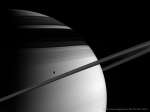 Saturn, Tethys, Rings, and Shadows
5.04.2015
Seen from ice moon Tethys, rings and shadows would display fantastic views of the Saturnian system. Haven't dropped in on Tethys lately? Then this gorgeous ringscape from the Cassini spacecraft will have to do for now.
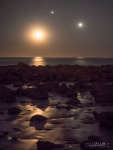 Triple Conjunction Over Galician National Park
24.06.2015
What are those bright objects hovering over the horizon? Planets -- and the Moon. First out, the horizon featured is a shoreline of the Atlantic Ocean that occurs at the Galicia National Park in northern Spain. Next furthest out, on the left, is the Moon.
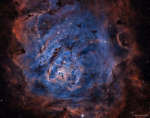 The Lagoon Nebula in Hydrogen Sulfur and Oxygen
5.01.2016
The majestic Lagoon Nebula is filled with hot gas and the home for many young stars. Spanning 100 light years across while lying only about 5000 light years distant, the Lagoon Nebula is so big and bright that it can be seen without a telescope toward the constellation of the Archer (Sagittarius).
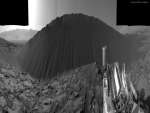 A Dark Sand Dune on Mars
19.01.2016
What is that dark sand dune doing on Mars? NASA's robotic rover Curiosity has been studying it to find out, making this the first-ever up-close investigation of an active sane dune on another world.
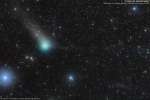 Comet PanSTARRS in the Southern Fish
17.06.2016
Now approaching our fair planet this Comet PanSTARRS (C/2013 X1) will come closest on June 21-22, a mere 5.3 light-minutes away. By then its appearance low in northern hemisphere predawn skies (high in the south), will be affected by the light of a nearly Full Moon, though.
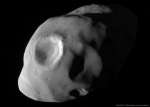 Pandora Close up at Saturn
3.01.2017
What do the craters of Saturn's small moon Pandora look like up close? To help find out, NASA sent the robotic Cassini spacecraft, now orbiting Saturn, past the unusual moon two weeks ago. The highest resolution image of Pandora ever taken was then captured from about 40,000 kilometers out and is featured here.
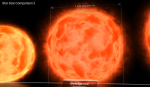 Star Size Comparison 2
12.06.2018
How big is our Sun compared to other stars? In dramatic and popular videos featured on YouTube, the relative sizes of planets, stars, and even the universe are shown from smallest to largest. The featured video begins with Earth's Moon and progresses through increasingly larger moons and planets in our Solar System.
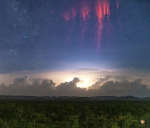 Red Sprite Lightning over Kununurra
25.02.2019
What are those red filaments in the sky? It is a rarely seen form of lightning confirmed only about 30 years ago: red sprites. Recent research has shown that following a powerful positive cloud-to-ground...
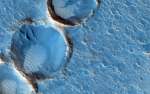 Ares 3 Landing Site: The Martian Revisited
22.06.2019
This close-up from the Mars Reconnaissance Orbiter's HiRISE camera shows weathered craters and windblown deposits in southern Acidalia Planitia. A striking shade of blue in standard HiRISE image colors, to the human eye the area would probably look grey or a little reddish.
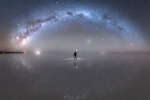 Night Sky Reflections from the Worlds Largest Mirror
22.10.2019
What's being reflected in the world's largest mirror? Stars, galaxies, and a planet. Many of these stars are confined to the grand arch that runs across the image, an arch that is the central plane of our home Milky Way Galaxy. Inside the arch is another galaxy -- the neighboring Large Magellanic Cloud (LMC).
|
January February March April May June July August September |
|||||||||||||||||||||||||||||||||||||||||||||||||