
|
You entered: stars
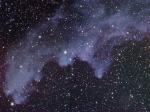 IC 2118: The Witch Head Nebula
26.12.2005
Double, double toil and trouble; Fire burn, and cauldron bubble -- maybe Macbeth should have consulted the Witch Head Nebula. This suggestively shaped reflection nebula is associated with the bright star Rigel in the constellation Orion.
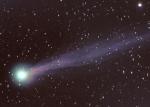 Comet SWAN Outburst
28.10.2006
Near its closest approach to planet Earth, comet SWAN (C/2006 M4) brightened unexpectedly earlier this week, becoming visible to naked-eye observers under dark night skies. Telescopic observers also noticed dramatic changes in the comet's colorful coma and tail, seen in this view recorded on October 25th.
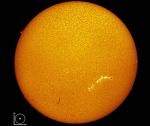 Simulated Transit of Mercury
7.11.2006
Mercury, the solar system's innermost planet, will spend about five hours crossing in front of the Sun today - beginning at 1912 UT (2:12pm EST), November 8. Specially equipped telescopes are highly recommended...
 Gigagalaxy Zoom: Milky Way
26.09.2009
Our magnificent Milky Way Galaxy sprawls across this ambitious all-sky panorama. In fact, at 800 million pixels the full resolution mosaic strives to show all the stars the eye can see in planet Earth's night sky.
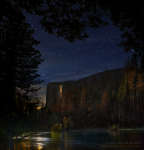 Firefall by Moonlight
7.06.2017
On certain dates in February, an elusive firefall can be spotted at sunset in Yosemite National Park, when the weather cooperates and the direction to the setting Sun is just right. Often photographed from...
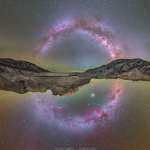 The Complete Galactic Plane: Up and Down
12.03.2018
Is it possible to capture the entire plane of our galaxy in a single image? Yes, but not in one exposure -- and it took some planning to do it in two. The top part of the featured image is the night sky above Lebanon, north of the equator, taken in 2017 June.
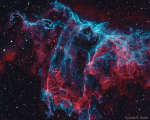 NGC 6995: The Bat Nebula
24.11.2019
Do you see the bat? It haunts this cosmic close-up of the eastern Veil Nebula. The Veil Nebula itself is a large supernova remnant, the expanding debris cloud from the death explosion of a massive star.
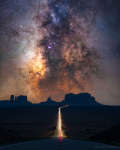 Road to the Galactic Center
24.10.2021
Does the road to our galaxy's center go through Monument Valley? It doesn't have to, but if your road does -- take a picture. In this case, the road is US Route 163 and iconic buttes on the Navajo National Reservation populate the horizon.
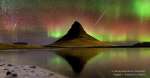 Meteors and Auroras over Iceland
12.12.2021
What's going on behind that mountain? Quite a bit. First of all, the mountain itself, named Kirkjufell, is quite old and located in western Iceland near the town of Grundarfjцrцur. In front...
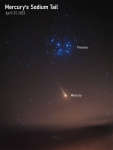 Mercurys Sodium Tail
2.05.2022
That's no comet. Below the Pleiades star cluster is actually a planet: Mercury. Long exposures of our Solar System's innermost planet may reveal something unexpected: a tail. Mercury's thin atmosphere contains small amounts of sodium that glow when excited by light from the Sun.
|
January February March April May June July August September October |
|||||||||||||||||||||||||||||||||||||||||||||||||