
|
You entered: star
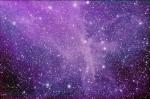 An Unexplored Nebula
29.09.2005
The combined light of the stars of the Milky Way are reflected by this cosmic dust cloud that soars some 300 light-years above the plane of our Galaxy. Dubbed the Angel Nebula by astronomer...
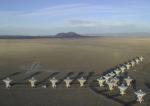 The Very Large Array Turns Twenty
30.05.2000
The most photogenic array of radio telescopes in the world has also been one of the most productive. Each of the 27 radio telescopes in the Very Large Array (VLA) is the size of a house and can be moved on train tracks.
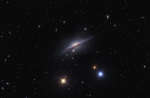 NGC 1055: Galaxy in a Box
24.04.2010
Big, beautiful spiral galaxy NGC 1055 is a dominant member of a small galaxy group a mere 60 million light-years away toward the intimidating constellation Cetus. Seen edge-on, the island universe spans about 100,000 light-years, similar in size to our own Milky Way.
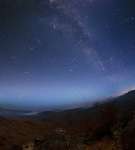 Lyrids in Southern Skies
24.04.2014
Earth's annual Lyrid meteor shower peaked before dawn on April 22nd, as our fair planet plowed through dust from the tail of long-period comet Thatcher. Even in the dry and dark Atacama desert along Chile's Pacific coast, light from a last quarter Moon made the night sky bright, washing out fainter meteor streaks.
 Window Seat over Hudson Bay
22.09.2018
On the August 18 night flight from San Francisco to Zurich, a window seat offered this tantalizing view when curtains of light draped a colorful glow across the sky over Hudson Bay. Constructed...
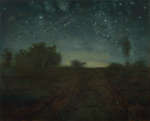 Starry Night by Jean Franцois Millet
13.03.2020
A dramatic nocturnal landscape from around 1850, this oil painting is the work of French artist Jean-Francois Millet. In the dark and atmospheric night sky are shooting stars, known too as meteors, above a landscape showing a path through the faintly lit countryside that leads toward trees and a cart in silhouette on the horizon.
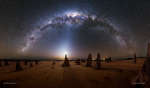 Milky Way over the Pinnacles in Australia
11.10.2020
What strange world is this? Earth. In the foreground of the featured image are the Pinnacles, unusual rock spires in Nambung National Park in Western Australia. Made of ancient sea shells (limestone), how these human-sized picturesque spires formed remains unknown.
 Flashes of the Crab Pulsar
9.02.2021
It somehow survived an explosion that would surely have destroyed our Sun. Now it is spins 30 times a second and is famous for the its rapid flashes. It is the Crab Pulsar, the rotating neutron star remnant of the supernova that created the Crab Nebula.
 The Large Cloud of Magellan
7.09.2023
The 16th century Portuguese navigator Ferdinand Magellan and his crew had plenty of time to study the southern sky during the first circumnavigation of planet Earth. As a result, two fuzzy cloud-like objects easily...
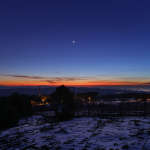 Twilight with Moon and Planets
21.02.2026
Only two days after the February New Moon's annular eclipse of the Sun, a slender lunar crescent poses above the western horizon after sunset in this wintry twilight skyscape. Its nightside faintly illuminated...
|
January February March April May June July August September October |
|||||||||||||||||||||||||||||||||||||||||||||||||