
|
You entered: image
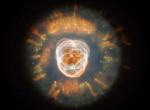 The Eskimo Nebula from the Newly Fixed Hubble
24.01.2000
In 1787, astronomer William Herschel discovered the Eskimo Nebula. From the ground, NGC 2392 resembles a person's head surrounded by a parka hood. In 2000, just after being fixed, the Hubble Space Telescope imaged the Eskimo Nebula. From space, the nebula displays gas clouds so complex they are not fully understood.
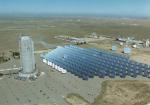 The 220 Mirrors of CRTF
4.10.1999
Even the largest of modern optical telescopes are small when compared with the light gathering power of the Central Receiver Test Facility (CRTF) located in New Mexico, USA. CRTF has 220 mirrors each over 7-meters in diameter all focused on a single tower.
 A Total Solar Eclipse Over China
5.08.2008
What's that black dot over the Sun? The Moon. This past weekend, the Sun went dark during the day as the Moon completely covered it. The total solar eclipse was visible over a thin swath of Earth extending from northern Canada to China.
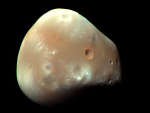 Martian Moon Deimos from MRO
16.03.2009
Mars has two tiny moons, Phobos and Deimos. Pictured above, in a recently release image by HiRISE camera onboard the Mars-orbiting Mars Reconnaissance Orbiter (MRO), is Deimos, the smaller moon of Mars. Deimos is one of the smallest known moons in the Solar System measuring only about 15 kilometers across.
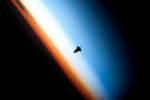 Dark Shuttle Approaching
16.02.2010
What's that approaching? Astronauts on board the International Space Station first saw it far in the distance. Soon it enlarged to become a dark silhouette. As it came even closer, the silhouette appeared to be a spaceship.
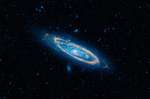 WISE Infrared Andromeda
19.02.2010
This sharp, wide-field view features infrared light from the spiral Andromeda Galaxy (M31). Dust heated by Andromeda's young stars is shown in yellow and red, while its older population of stars appears as a bluish haze. The false-color skyscape is a mosaic of images from NASA's new Wide-field Infrared Survey Explorer (WISE) satellite.
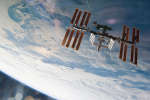 The International Space Station from Above
3.03.2010
The International Space Station (ISS) is the largest human-made object ever to orbit the Earth. The ISS is so large that it can be seen drifting overhead with the unaided eye, and is frequently imaged from the ground in picturesque fashion.
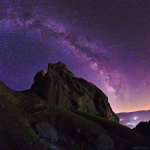 The Starry Night of Alamut
25.06.2010
A meteor's streak and the arc of the Milky Way hang over the imposing mountain fortress of Alamut in this starry scene. Found in the central Alborz Mountains of Iran, Alamut Castle was built into the rock in the 9th century. The name means Eagle's Nest.
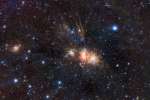 Vista with NGC 2170
15.10.2010
Drifting through the one-horned constellation Monoceros, these dusty streamers and new born stars are part of the active Monoceros R2 star-forming region, embedded in a giant molecular cloud. The cosmic scene was recorded by the VISTA survey telescope in near-infrared light.
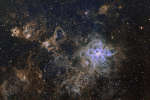 The Cosmic Web of the Tarantula Nebula
11.01.2011
It is the largest and most complex star forming region in the entire galactic neighborhood. Located in the Large Magellanic Cloud, a small satellite galaxy orbiting our Milky Way galaxy, the region's spidery appearance is responsible for its popular name, the Tarantula nebula. This tarantula, however, is about 1,000 light-years across.
|
January February March April May June July August September |
|||||||||||||||||||||||||||||||||||||||||||||||||