
|
You entered: Earth
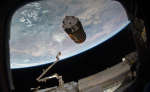 Japans Kounotori2 Supply Ship Approaches the Space Station
31.01.2011
The care package from Earth had arrived. Last week, Japan launched the robotic Kounotori2 spacecraft to bring needed supplies, including food, to the International Space Station (ISS). Kountori2 launched from Japan's Tanegashima Space Center a little over a week ago reached the ISS in low Earth late last week.
 APOD: 2024 June 30 Б Earthrise: A Video Reconstruction
30.06.2024
About 12 seconds into this video, something unusual happens. The Earth begins to rise. Never seen by humans before, the rise of the Earth over the limb of the Moon occurred about 55.5 years ago and surprised and amazed the crew of Apollo 8.
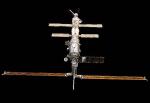 Approaching the International Space Station
30.04.2001
Earlier this month the crew of the US Space Shuttle Endeavor took in this view as they approached the developing International Space Station (ISS). The Endeavor and ISS crew installed Italy's Raffaello...
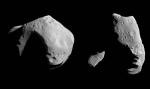 Asteroids
13.03.1998
No asteroid or comet is known to be on a collision course with Earth. The asteroid designated 1997 XF11 had been predicted to come uncomfortably close, but new estimates place its passing beyond the orbit of the Moon. This earth-approaching asteroid was discovered by SpaceWatch astronomer Jim Scotti in December of last year.
 Conjunction by the Sea
26.06.2014
Early morning risers were treated to a beautiful conjunction of Venus and waning Crescent Moon on June 24, captured in this seaside photo near Belmar, New Jersey, USA, planet Earth. The serene celestial pairing is seen above the Atlantic Ocean horizon as the eastern sky grows brighter with dawn's early light.
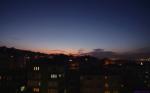 Venus Just After Sunset
1.02.2006
Is that Venus or an airplane? A common ponderable for sky enthusiasts is deciding if that bright spot near the horizon is the planet Venus. Usually, an airplane will show itself by moving significantly in a few moments. Venus will set only slowly as the Earth turns.
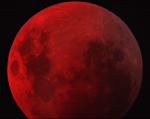 Dark Lunar Eclipse
30.08.2007
The Moon passed close to the center of Earth's shadow on August 28th. Seen best by skywatchers in western North America, and the Pacific region, the resulting total lunar eclipse was a dark one, lasting about 90 minutes.
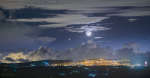 Earthshine Moon over Sicily
18.10.2021
Why can we see the entire face of this Moon? When the Moon is in a crescent phase, only part of it appears directly illuminated by the Sun. The answer is earthshine, also known as earthlight and the da Vinci glow.
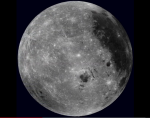 Rotating Moon from LRO
19.07.2020
No one, presently, sees the Moon rotate like this. That's because the Earth's moon is tidally locked to the Earth, showing us only one side. Given modern digital technology, however, combined with many detailed images returned by the Lunar Reconnaissance Orbiter (LRO), a high resolution virtual Moon rotation movie has been composed.
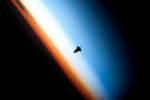 Dark Shuttle Approaching
16.02.2010
What's that approaching? Astronauts on board the International Space Station first saw it far in the distance. Soon it enlarged to become a dark silhouette. As it came even closer, the silhouette appeared to be a spaceship.
|
January February March April May June July August September October |
|||||||||||||||||||||||||||||||||||||||||||||||||