
|
You entered: Venus
 Solar System Family Portrait
13.02.2019
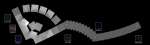
On Valentine's Day in 1990, cruising four billion miles from the Sun, the Voyager 1 spacecraft looked back one last time to make this first ever Solar System family portrait. The complete portrait is a 60 frame mosaic made from a vantage point 32 degrees above the ecliptic plane.
 Tutulemma: Solar Eclipse Analemma
19.12.2009
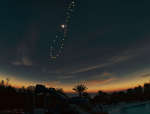
If you went outside at exactly the same time every day and took a picture that included the Sun, how would the Sun appear to move? With great planning and effort, such a series of images can be taken. The figure-8 path the Sun follows over the course of a year is called an analemma.
 Solar System Portrait
13.02.2015
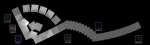
On another Valentine's Day 25 years ago, cruising four billion miles from the Sun, the Voyager 1 spacecraft looked back one last time to make this first ever Solar System family portrait. The complete portrait is a 60 frame mosaic made from a vantage point 32 degrees above the ecliptic plane.
 Earth and Moon through Saturns Rings
26.05.2020
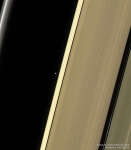
What are those dots between Saturn's rings? Our Earth and Moon. Just over three years ago, because the Sun was temporarily blocked by the body of Saturn, the robotic Cassini spacecraft was able to look toward the inner Solar System.
 Mercury Spotting
8.05.2003
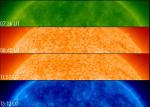
Can you spot the planet? The diminutive disk of Mercury, the solar system's innermost planet, spent about five hours crossing in front of the enormous solar disk yesterday (Wednesday, May 7th), as viewed from the general vicinity of planet Earth.
 Bright Planets at McMath Pierce Solar Telescope
16.03.2012
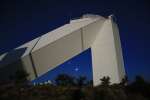
Bright planets Venus and Jupiter are framed by the National Solar Observatory's McMath-Pierce Solar Telescope in this very astronomical scene. The photo was taken at Kitt Peak National Observatory on March 9.
 A Total Solar Eclipse of Saros 145
10.08.2017
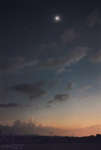
A darkened sky holds bright planet Venus, the New Moon in silhouette, and the shimmering corona of the Sun in this image of a total solar eclipse. A composite of simultaneous telephoto and wide angle frames it was taken in the path of totality 18 years ago, August 11, 1999, near Kastamonu, Turkey.
 August Moons
21.08.2008
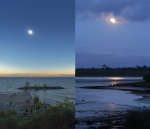
This August was eclipse season. The month's first New Moon and Full Moon were both seen in darkened skies during a solar and lunar eclipse. Blocking the Sun, the left panel...
 The Case of the Very Dusty Binary Star
25.09.2008
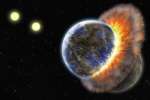
For astronomers, close binary star system BD+20 307 originally stood out because it is extremely dusty. A substantial amount of warm dust surrounding it causes the system to appear exceptionally bright at infrared wavelengths. Of course, dust associated with planet formation is often detected around young stars, stars only a few million years old.
 Welcome to the International Year of Astronomy
31.12.2008
Astronomers all over planet Earth invite you to experience the night sky as part of the International Year of Astronomy 2009. This year was picked by the International Astronomical Union and the United Nations Educational, Scientific, and Cultural Organization because it occurs 400 years after Galileo turned one of the first telescopes toward the heavens.
|
January February March April May June July August September October |
|||||||||||||||||||||||||||||||||||||||||||||||||